Lab-Made Gold Is Real. The Gold Price Threat Isn't.
A fusion startup says it turned mercury into gold at 10x CERN's record. We check the physics, the scale, and whether lab-made gold could move the gold price.
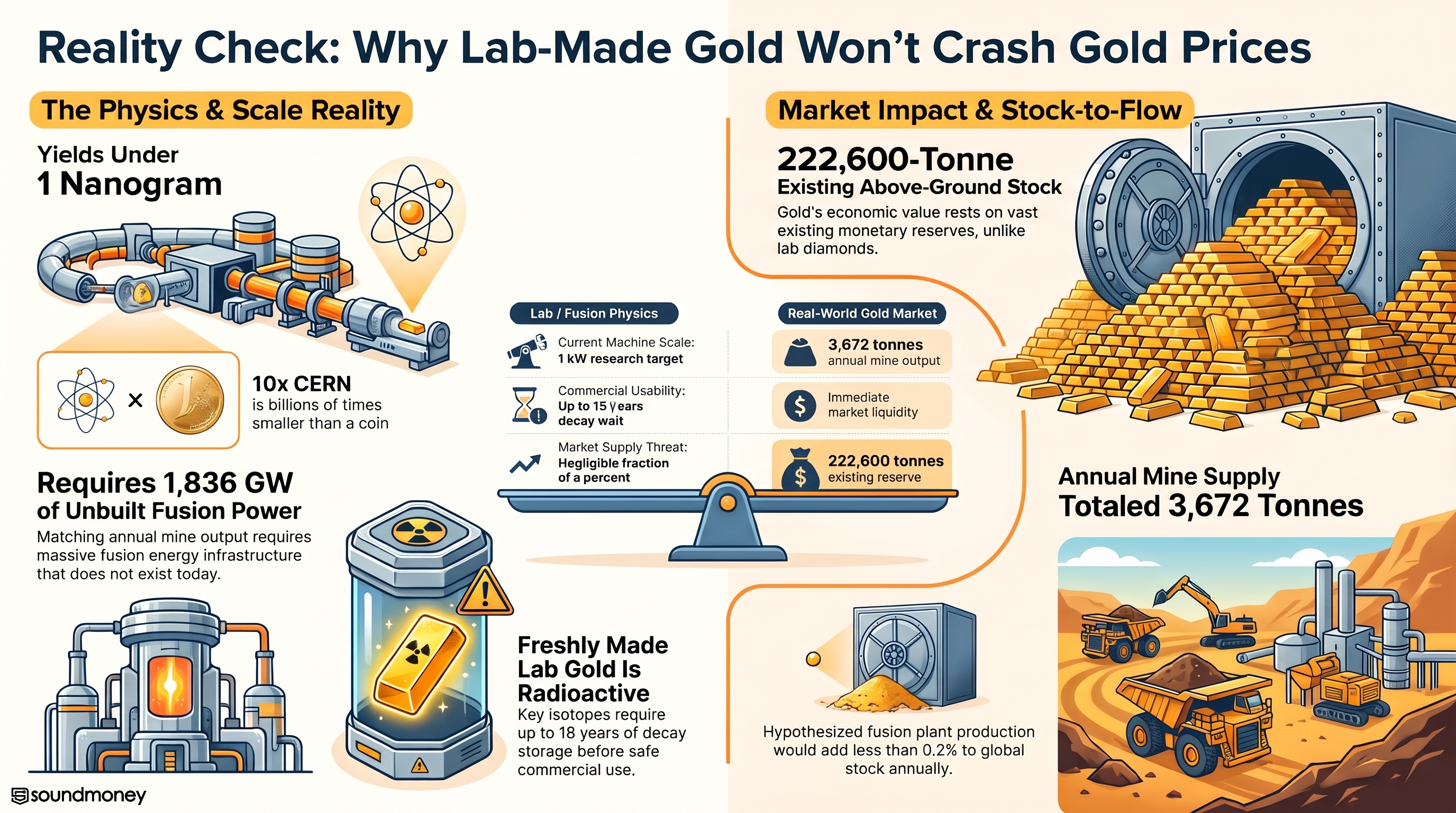
On Wednesday, October 21, a 28-person San Francisco startup posted a sentence alchemists would have killed for. "Last month, we demonstrated high-rate alchemy: turning mercury into real, stable gold, beating CERN's record by a factor of 10," Marathon Fusion wrote on X. By October 25, the post had been viewed more than 8.8 million times. By Thursday, the headlines had moved on to the obvious question: could lab-made gold crash prices like diamonds?
It landed in a rough week for the metal. Front-month COMEX gold fell 4.05% to settle at $3,991.10 on Friday, October 23, its worst week since June, and silver fell 5.76% to $53.711. So "scientists can now make gold" hit a nervous audience.
Here is our honest read. The physics is real, the company is serious, and the headlines oversell it by many orders of magnitude. Let's walk through why.
The Story
What Marathon actually claimed
Marathon Fusion was founded in 2023 and builds fuel systems for future fusion power plants. Per Euronews, its backers include Bill Gates's Breakthrough Energy and Anglo American, the mining group that owns De Beers. In a follow-up post in the same thread, the company said: "Mercury transmuted into stable gold, using fusion neutrons, at 10x the record set by CERN in 2025."
The process is textbook nuclear physics. A fast 14 MeV neutron from a deuterium-tritium fusion reaction strikes mercury-198, a stable isotope, and knocks out a second neutron. That leaves mercury-197, which is radioactive with a half-life of about 64 hours and decays into gold-197, the only stable form of gold. Marathon laid out the idea in a July 2025 preprint, which has not been peer reviewed.
What it did not say
This is the part the headlines skipped. As of October 25, Marathon has not disclosed:
- How much gold it made. No mass, no atom count (Business Standard).
- What "10x CERN" measures. Total mass, atoms per second, or something else (CNBC TV18).
- Purity, cost, or a method others can replicate. Its evidence so far is gamma-ray spectra posted on X (Yahoo Tech).
None of that makes the claim false. It means the claim is unverified, and that "10x" is doing a lot of work in the headlines.
"10x CERN" is still almost nothing
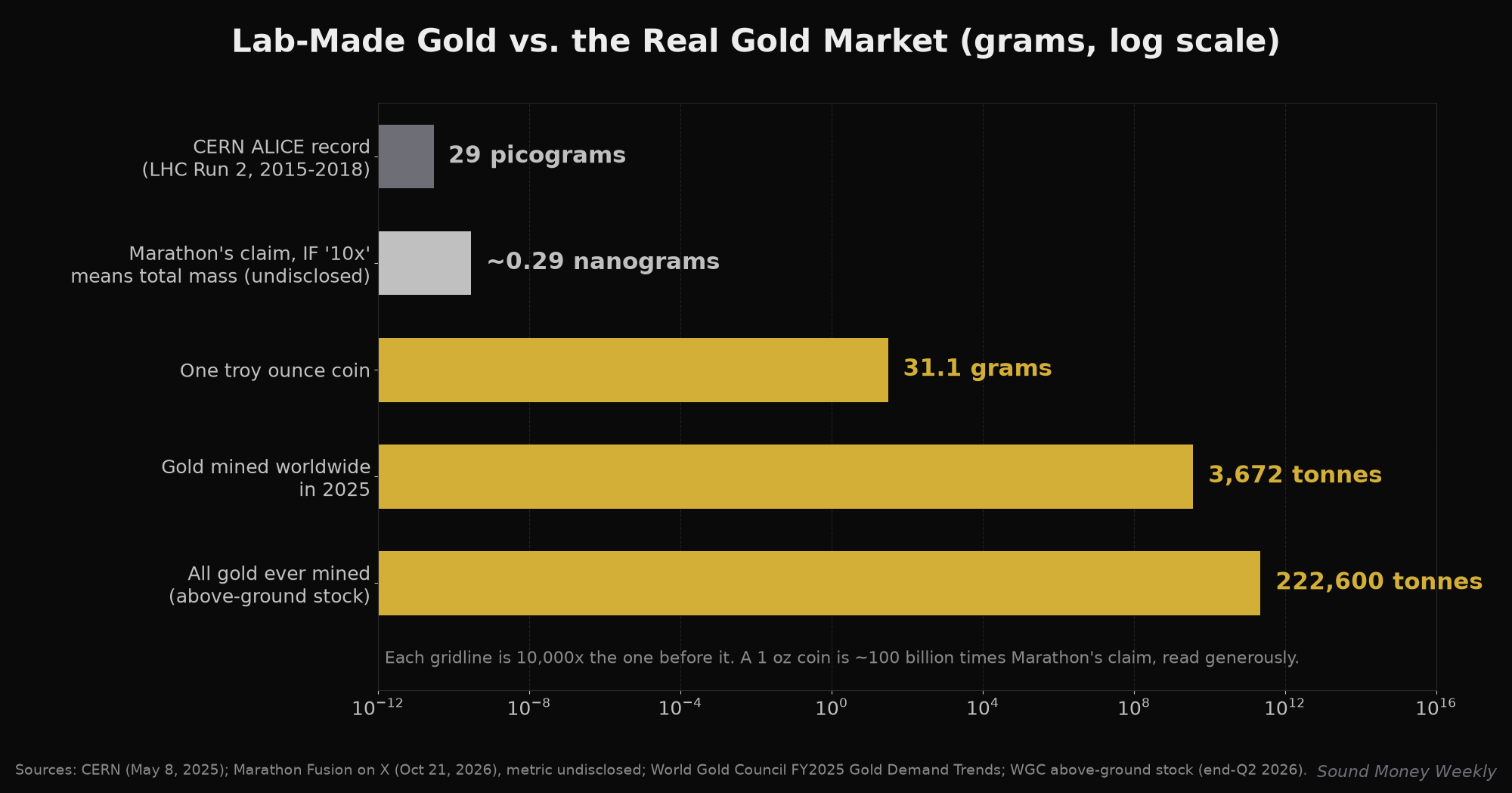
In May 2025, CERN's ALICE experiment reported that near-miss collisions of lead nuclei in the Large Hadron Collider created about 86 billion gold nuclei during Run 2 (2015 to 2018). In mass, that is 29 picograms, or 29 trillionths of a gram, made over about four years. CERN's own summary: "the dream of medieval alchemists has technically come true," but "their hopes of riches have once again been dashed."
Read Marathon's claim as generously as possible and assume "10x" means ten times CERN's total mass. That is roughly 0.3 nanograms. A single one-ounce coin weighs 31.1 grams, about 100 billion times more. The world's mines produced 3,672 tonnes in 2025, according to the World Gold Council.
This isn't a knock on Marathon. The company itself pitches gold as a byproduct of fusion power plants that don't exist yet, not something it can make today.
Under the Hood
The model behind the "tonnes" headlines
The big numbers in the coverage come from Marathon's 2025 paper, which uses neutronics simulations, not experiments. The paper models a tokamak power plant with a mercury layer in its blanket and estimates gold output of about 2 tonnes per gigawatt of thermal power per year (arXiv:2507.13461). Its main configuration produced 2,953 kg a year in a 1.5 GW thermal plant.
That squares with the "5 tonnes per gigawatt" figure in Euronews and Business Standard. The paper assumes 40% conversion of heat to electricity, so 2 tonnes per thermal gigawatt works out to about 5 tonnes per electric gigawatt. Same model, different units.
The paper's assumptions matter as much as its output:
- Enriched feedstock. Natural mercury is only about 10% mercury-198. The model assumes mercury enriched to 90% mercury-198, and an initial inventory of roughly 100 to 450 tonnes per thermal gigawatt.
- A working power plant. The 2 t/GWth figure assumes a gigawatt-scale fusion plant that breeds its own tritium fuel. As Euronews notes, no fusion plant sells electricity today.
From 1 kW to 1,836 GW
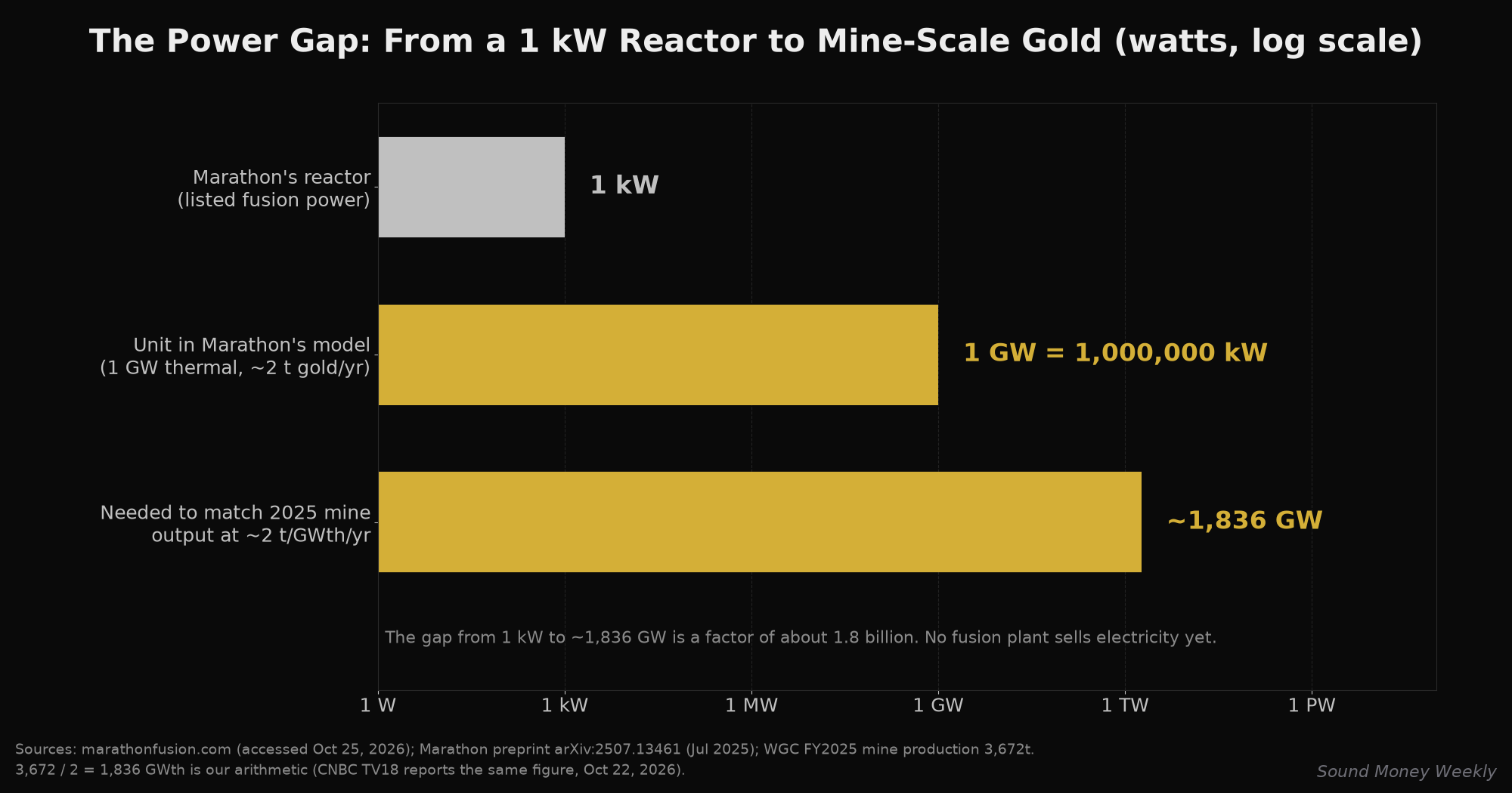
Marathon's website lists the reactor it is building in San Francisco at 1 kW of fusion power. One gigawatt is a million times that. At 2 tonnes per thermal gigawatt, matching 2025 mine output would take about 1,836 GW of fusion heat, which is our arithmetic and the same figure CNBC TV18 calculated. The 1 kW machine is a beam-on-target neutron source, not a tokamak with a gold-making blanket, so its output can't simply be scaled up from the paper.
Freshly made gold is radioactive
The same neutrons that turn mercury-198 into gold also hit the small amount of mercury-196 in the feedstock. That route produces gold-195, which has a half-life of 186 days. The coverage has given this as "up to 18 years" and "7 to 17 years." The preprint's own figures for its modeled mix are:
| Threshold (per Marathon's preprint) | Storage time |
|---|---|
| Below the NRC's Class A low-level waste limit | ~6.8 years |
| No radioactive labeling required | ~13.7 years |
| Less radioactive than a banana, per troy ounce | ~17.7 years |
The paper notes that more enrichment could shorten these times, and it treats them as a discount on freshly made gold rather than a deal breaker.
What the spectra do and don't show
The German science site Forschung und Wissen (Oct 22) went through Marathon's posted gamma spectrum. It was measured 8, 20, 32 and 44 hours after irradiation, and the signals fade the way a roughly 64-hour isotope should. That is consistent with the mercury-to-gold chain. But the site also found no sample size, neutron count, irradiation time or neutron source, and it pointed out that the line labeled as gold sits just 0.2 keV from a mercury-203 line. A peer-reviewed paper would settle these questions.
What It Means
Why the diamond analogy breaks down
Lab-grown diamonds did real damage. Per Euronews, wholesale prices for lab-grown stones fell 90% to 95% from 2015 levels, and De Beers shut its lab-grown brand Lightbox in 2025. But that happened because factories could make diamonds cheaply with established industrial methods, at volumes that changed the market. Lab-made gold has neither the cost nor the volume.
There's a second difference. Diamonds are mostly bought to be worn. Gold's price rests on a huge existing stock that people hold as money. The World Gold Council estimates 222,600 tonnes of gold sit above ground, including about 39,000 tonnes held by central banks. Mines add only about 1.6% to that stock each year (our math from the WGC figures). That slow growth relative to the existing stock, sometimes called stock-to-flow, is what makes gold gold.
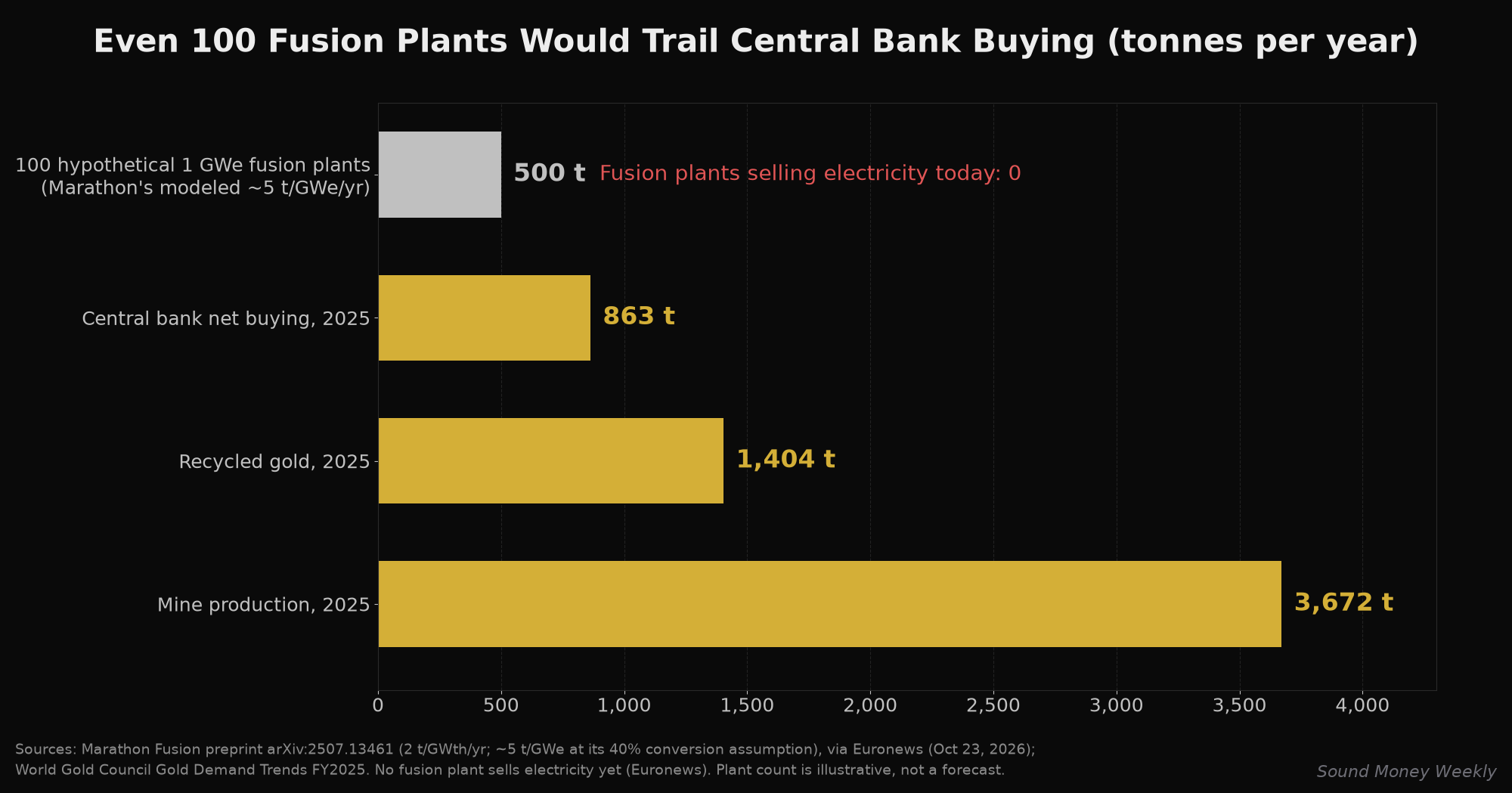
Now take the most generous scenario in the coverage: 100 one-gigawatt plants making 500 tonnes a year, which Euronews put at about 14% of mine output. That would add roughly 0.2% to the above-ground stock each year. Central banks alone bought 863 tonnes in 2025.
Alchemy has happened before, and it was never cheap
This isn't the first time science has made gold. In 1980, Glenn Seaborg's team at Lawrence Berkeley turned bismuth into gold in a particle accelerator. Seaborg told the AP that "it would cost more than one quadrillion dollars per ounce" when gold was about $560 (Scientific American). CERN's record came 45 years later. Each time, the hard part wasn't the physics. It was the cost and the scale.
Marathon's more credible business
Marathon may already be telling us where its near-term value lies. In the same thread, it said it had made medical isotopes by turning zinc into radioactive copper used in cancer diagnostics and therapy. Its website describes making actinium-225, a cancer-drug ingredient, from radium. The company's own preprint puts the medical isotope market at about $5 billion a year. Small amounts sell for high prices there, which suits a 1 kW machine far better than gold does.
The DCA angle
For anyone building a gold position over time, this story is a useful stress test of the thesis, not a threat to it. The supply question that matters is whether gold's stock keeps growing slowly. Mine production has averaged under 1% annual growth over the past decade, per the WGC, and nothing announced last week changes that. A steady, scheduled purchase plan doesn't need a view on fusion timelines. It needs gold to stay scarce relative to the stock already above ground, and the data say it does.
What We're Watching
- A peer-reviewed paper or independent replication from Marathon. The minimum would be the mass of gold produced, the neutron source and dose, and purity. Until then, the "10x CERN" claim stays a company statement.
- Wednesday, October 28: FOMC decision (2:00 p.m. ET). After gold's 4% drop, the statement and any December signal matter more than the decision itself.
- Thursday, October 29: PCE inflation and advance Q3 GDP, plus the ECB decision, per Kitco's calendar.
- Early November: the WGC's Q3 Gold Demand Trends. This is the real supply and demand picture, including whether central bank buying is keeping pace with 2025's 863 tonnes. Our earlier look at central bank buying has the background.
We will be back next Monday with the post-FOMC read. For our look at the CPI-driven split between the metals, see Silver Fell 6% in a Day. Gold Finished the Week Flat.
Sound Money exists to make consistent precious metals accumulation accessible. You can learn more at sound.money.
Disclaimer: This content is provided by Sound Money for educational and informational purposes only. Nothing published here constitutes investment advice, financial advice, trading advice, or any other form of professional advice. Sound Money is not a registered investment advisor, broker-dealer, or financial planner. The information presented reflects our analysis of publicly available data and should not be relied upon as a basis for investment decisions. Precious metals investments carry risk, including the potential loss of principal. Past performance does not guarantee future results. Always consult a qualified financial advisor before making investment decisions. For more information about Sound Money's products and services, visit sound.money.
- gold
- precious-metals
- lab-made-gold
- nuclear-fusion
- gold-supply
- central-banks
- stock-to-flow