Tokenized Gold Became Dollars. What Did Holders Own?
Coinbase converted EEA retail PAX Gold balances to USDC on Oct 30. What tokenized gold holders actually own: allocated vs unallocated gold, explained.
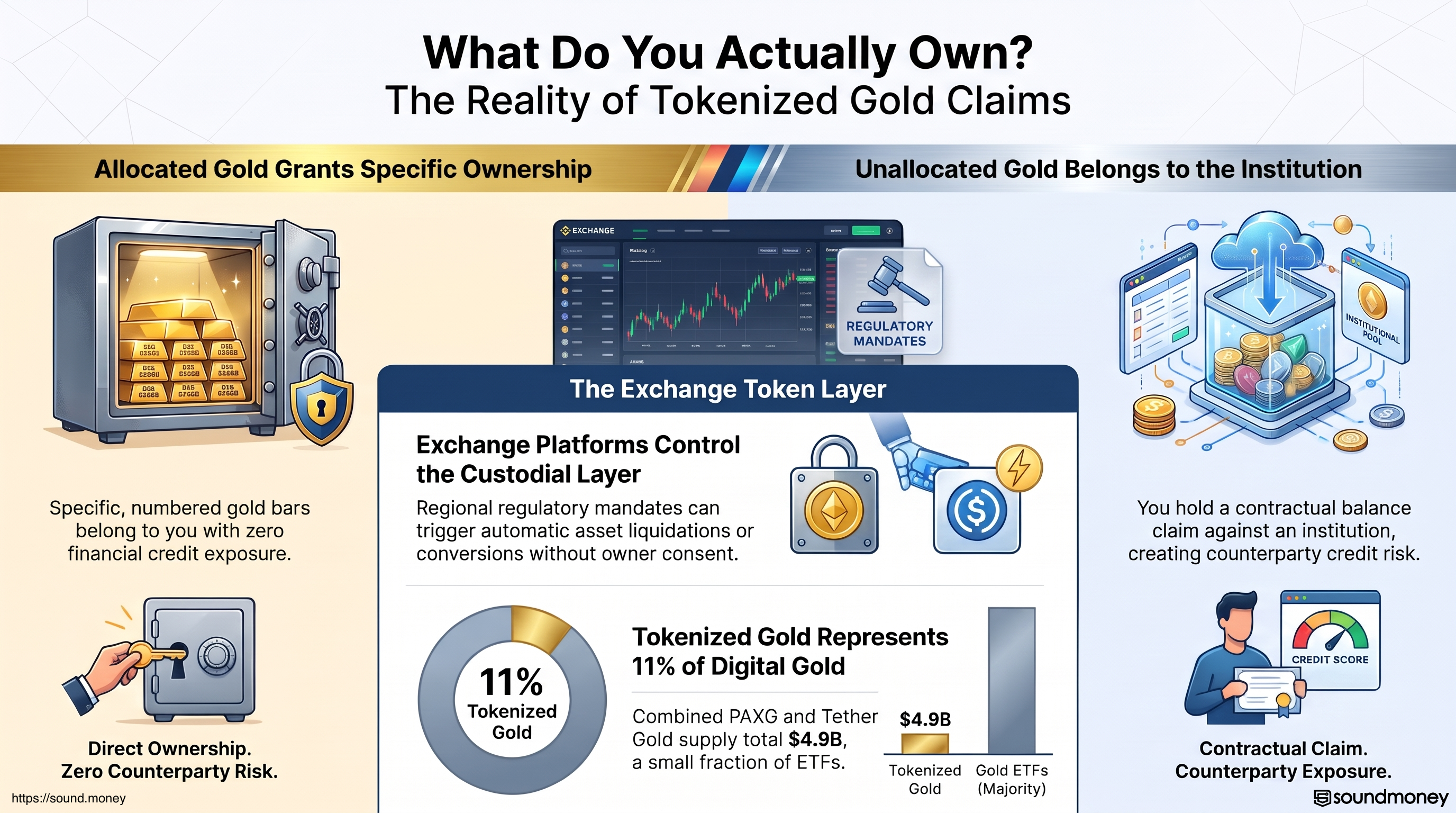
Coinbase turned some customers' gold tokens into dollars without asking them. The gold was fine; their ownership of it wasn't. Here's how to tell what kind of gold you actually own.
On Friday, October 30, retail customers in the European Economic Area (EEA, the EU plus Iceland, Liechtenstein and Norway) who still held PAX Gold on Coinbase ended the day holding USDC instead. PAX Gold is a tokenized gold product, meaning a digital token that stands for a set amount of physical gold, issued by a company called Paxos. USDC is a stablecoin, a digital token built to stay worth one US dollar. They did not sell anything. Under a published notice, Coinbase converted every remaining EEA retail balance of PAX Gold (PAXG) into USDC at the market rate, along with 13 other tokens it can no longer support under the EU's Markets in Crypto-Assets Regulation (MiCA).
MiCA is the European Union's rulebook for crypto, the first to cover the whole bloc. Among other things, it says that anyone issuing a token pegged to something else (a stablecoin pegged to a currency like the dollar, or a token pegged to an asset like gold) must be authorized by an EU regulator and meet reserve, redemption and disclosure rules. Platforms licensed under MiCA are only supposed to offer tokens from issuers that have that authorization.
The same week, Binance lost about $6.3 billion from its hot wallets in the largest crypto theft on record. (A hot wallet is an internet-connected wallet an exchange uses for everyday payouts.) And on Friday, front-month COMEX gold (the New York futures contract closest to expiring, which is the price most headlines quote) had its largest one-day drop since September 28, falling 3.29% to finish October down 6.49% at $3,885.70, while silver lost 18.31% for the month to $49.097.
The price slide got the headlines. The tokenized gold story is the one worth your time, because it forces a question most owners never ask: when you say you own gold, what exactly do you own?
The Story
What Coinbase actually did
Coinbase's help page is unusually plain. Trading in the affected assets was already restricted, and EEA retail customers could withdraw them to an outside wallet until October 30. Anything left would be converted "into USDC, where suitable," as a one-time conversion, and Coinbase warned that the swap "may be a taxable event in some jurisdictions." Tokens sent to Coinbase after the deadline "will not be credited," and recovery "is not guaranteed."
The reason given is regulatory. Under MiCA, Coinbase says, these assets count as e-money tokens (pegged to a single currency) or asset-referenced tokens (pegged to something else, such as gold), the "MiCA transitional period for stablecoin issuers ended on July 1, 2026, and was not extended," and Coinbase "can no longer support stablecoins whose issuer is not MiCA-authorised." Crypto trade outlet Cryptoticker reports that no issuer has yet been authorized as an asset-referenced token issuer; we have not verified that against the EU register.
Why the regulator forced the issue
The trigger was an October 8 opinion from ESMA, the European Securities and Markets Authority, the EU's securities regulator. It says authorized crypto platforms should stop providing services for non-compliant tokens across the board, including trading, transfers, "custody and administration." Leftover exposures should be cleaned up "no later than three months" after publication, which points to early January 2027. The opinion adds that warnings and client acknowledgements "would not sufficiently address the concerns." A disclaimer was not enough.
The gold never moved
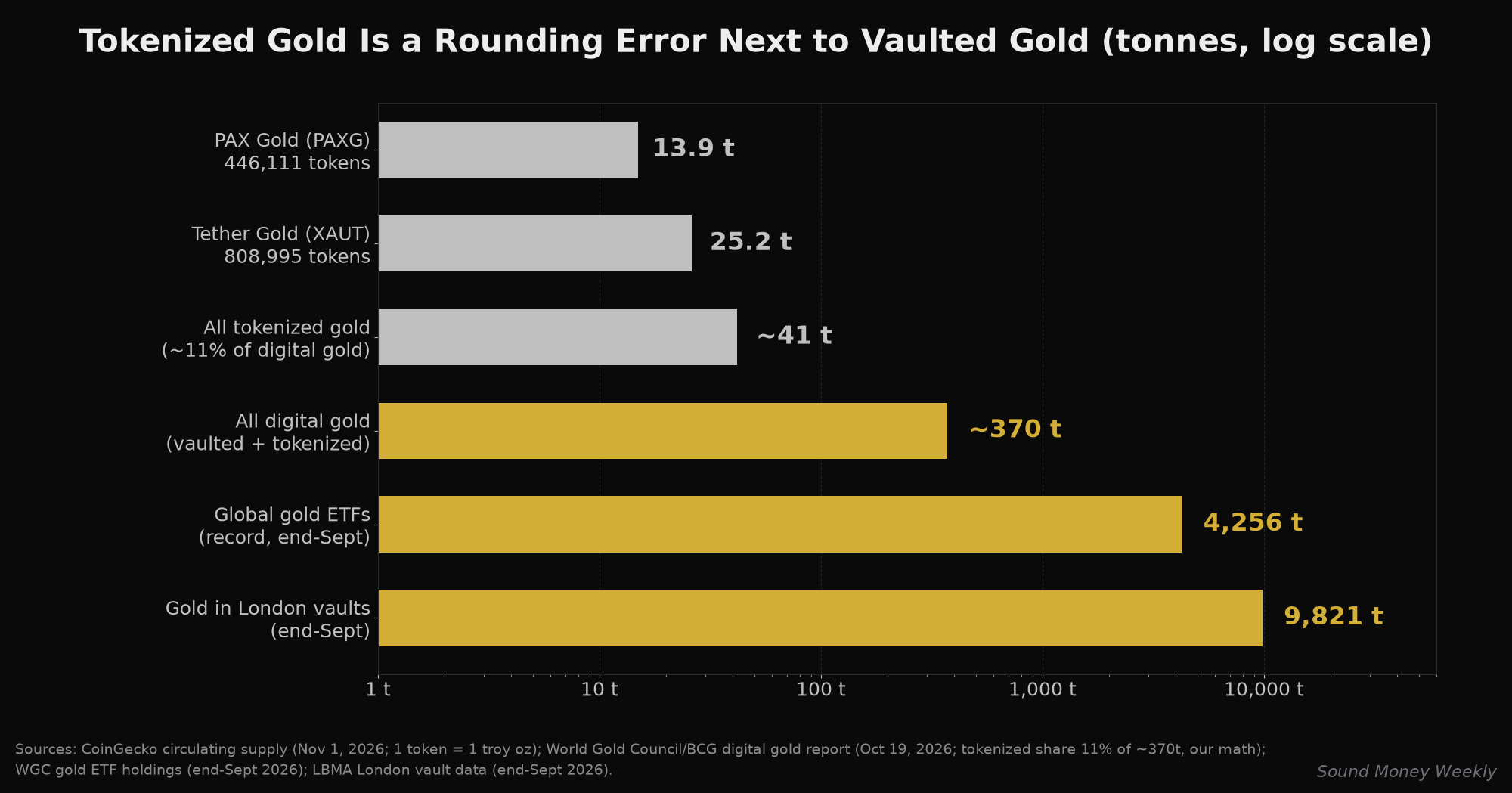
This is the detail that matters most. PAXG's circulating supply on CoinGecko was still about 446,111 tokens on November 1, roughly 13.9 tonnes at one troy ounce per token (our conversion). A troy ounce is the standard unit for precious metals, about 31.1 grams. A conversion on an exchange is a sale, not a redemption. The bars behind the token stayed in the vault. What changed is that EEA retail holders on one platform went from holding a gold claim to holding a dollar claim, without taking any action.
Holding PAXG itself is not banned; Coinbase offered withdrawal to a personal wallet. The rule binds regulated platforms, and the platform decided what happened to balances left with it.
What it cost the holders
The conversion was at the market rate, so nobody's balance was marked down that day. The costs come from not having a choice:
- They no longer own gold. A holder who wanted gold now holds dollars. Getting back in means buying again, paying another spread (the gap between a seller's buy price and sell price) and fees, at whatever the price is then.
- The timing wasn't theirs. The deadline fell on October 30, when front-month gold dropped 3.29%, its biggest one-day fall in a month, to close out a 6.49% monthly loss. Holders who might have waited were sold anyway.
- A possible tax bill. Coinbase's own notice warns the swap "may be a taxable event in some jurisdictions." Anyone with gains could owe tax on a sale they never chose to make.
- Late transfers are at risk. Tokens sent to Coinbase after the deadline "will not be credited," and recovery "is not guaranteed."
None of this means holders were cheated. They were warned, and they could withdraw first. But a decision they never made turned their gold into dollars.
Meanwhile, at Binance
The Binance theft is a different failure with the same lesson. Analytics firms attributed it to North Korea's TraderTraitor group, and CoinDesk reported the attacker took about $6.3 billion from hot wallets, the online wallets an exchange uses for everyday payouts. Binance says it has replaced about 95% of the stolen assets with company funds, about $3 billion is frozen, and withdrawals restarted in phases on Sunday, November 1. It says "these losses will not be passed on to users." Good news for its customers, and a reminder of what an exchange balance is: a promise from the exchange.
Under the Hood
Allocated vs. unallocated gold, in the LBMA's own words
The London Bullion Market Association (LBMA), the trade body for London's wholesale gold market, publishes an OTC guide that lays out the two basic ways wholesale gold is held.
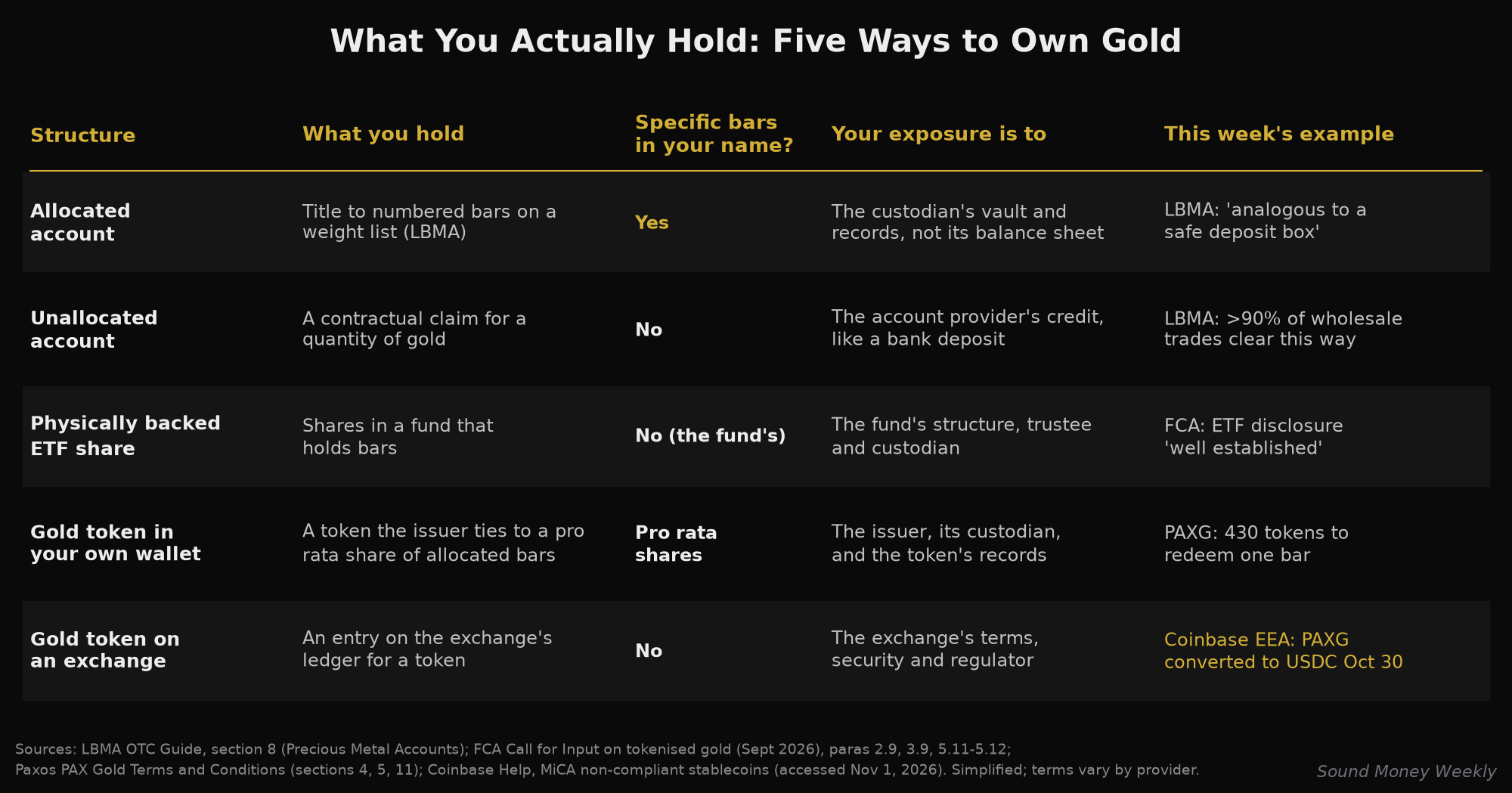
- Unallocated: "the account holder has a contractual claim against the clearer rather than a specific bar," so "the owner of the metal has credit exposure to the institution where the account is held." The LBMA compares it to a checking account. It estimates that "in excess of 90%" of wholesale precious metals trades clear this way, because it is fast and convenient.
- Allocated: the account "is backed by a specific bar," shown on a weight list with serial numbers, weights and fineness. It "cannot, by definition, be overdrawn," and the investor "does not have a credit exposure" to the account operator. The LBMA's analogy is "a safe deposit box." One catch: the owner is usually "responsible for arranging their own insurance."
Here is a simple way to picture it. Allocated gold is like a safe deposit box with your name on it: what's inside is yours. Unallocated gold is like a bank balance: a number the bank owes you. And a gold token held on an exchange is like a coat-check ticket. That last comparison is our analogy, not the LBMA's: the coat exists, but the venue controls what happens to your ticket.
Neither is wrong. They trade certainty of title against convenience, and the UK's financial regulator, the Financial Conduct Authority (FCA), describes the same trade-off. In its tokenised gold Call for Input (September 2026), it notes that allocated gold "gives stronger certainty of ownership" but is "slower and more costly to mobilise," while unallocated gold "represents a claim on an account provider, introducing counterparty exposure."
Where tokenized gold sits
Paxos's PAX Gold terms say each PAXG equals one fine troy ounce of London Good Delivery gold (bars that meet the LBMA's purity and size standards), and that tokens "represent fractional ownership" of bars held by Paxos Trust "on a segregated basis" in LBMA-approved vaults. Two details matter. Paxos "may reallocate your PAXG tokens to different bars from time to time," and swapping tokens for a physical bar has a large minimum (430 tokens, about $1.67 million at Friday's settle, our arithmetic). Paxos says auditor Withum attests monthly that token supply matches gold held.
So a token in your own wallet is a claim structured around allocated bars. The same token in an exchange account adds one more layer: the exchange's ledger, its security, and its regulator. The Coinbase conversion happened entirely in that last layer.
The line between owning a bar and owning a fund
The FCA's paper goes further than most regulators have. Its test is not whether a product is fractional. It is whether each owner holds a direct interest in specific, allocated gold, or a share of a pot that is "managed or disposed of collectively" for the group. It says products giving "a direct, allocated ownership interest in gold, with no pooling" are "more likely to fall outside" UK fund rules, while the collectively managed kind would "indicate pooling" of the sort fund rules cover. This is a UK consultation, not a rule, and it doesn't apply to US products. It lists 12 areas any bespoke regime would need, from custody and segregation to reconciling vault and on-chain records to "orderly wind-down arrangements" in insolvency. And it says plainly that, unlike gold ETFs, "inconsistent practice continues to exist in the tokenised gold space."
The comment period closed October 23. The LBMA's response asks for clarity on "the treatment of different token structures." No rules have changed yet.
How big is tokenized gold, really?
Smaller than the headlines suggest, much like last week's lab-made gold claim. The two largest tokens, PAXG and Tether Gold (about 809,000 tokens, or 25.2 tonnes), add up to about 39 tonnes and $4.9 billion as of November 1. The World Gold Council and BCG sized all digital gold at $45 to $55 billion, with tokenized gold about 11% of the value, roughly 41 tonnes (our math).
For scale, gold ETFs (funds that trade like stocks and hold physical gold) held a record 4,256 tonnes at the end of September, and London vaults held 9,821 tonnes. This was a custody event, not a market-moving one.
What It Means
In plain English: nothing in this episode suggests a problem with the gold behind PAXG. What failed, for one group of holders, was the route to it. Their claim ran through a platform, the platform answered to a regulator, and the regulator decided the product could not stay.
That is not a knock on tokens, ETFs or exchanges. Each solves a real problem: cost, divisibility, liquidity or transferability. But every structure has a "who," and the who determines what can happen to your gold without you. Four questions cover most of it:
- Do I own specific bars, or a claim for a quantity of gold?
- If it's a claim, who is it against: a bank, a fund, an issuer, an exchange?
- What can that party do without my action: reallocate, convert, freeze, delist?
- What happens if that party fails?
We are not saying any custody model is risk-free. We are saying the answers differ, and they belong in the same mental file as the price.
On price, October was rough. Kitco's survey found 10 of 16 Wall Street analysts bearish for the week ahead after spot gold hit $3,870.25, its weakest in more than a year. Front-month gold is down 10.17% year to date and 26.94% below its January 29 record settle of $5,318.40, per Dow Jones. Silver has given back even more.
For the DCA investor, the week did the quiet work:
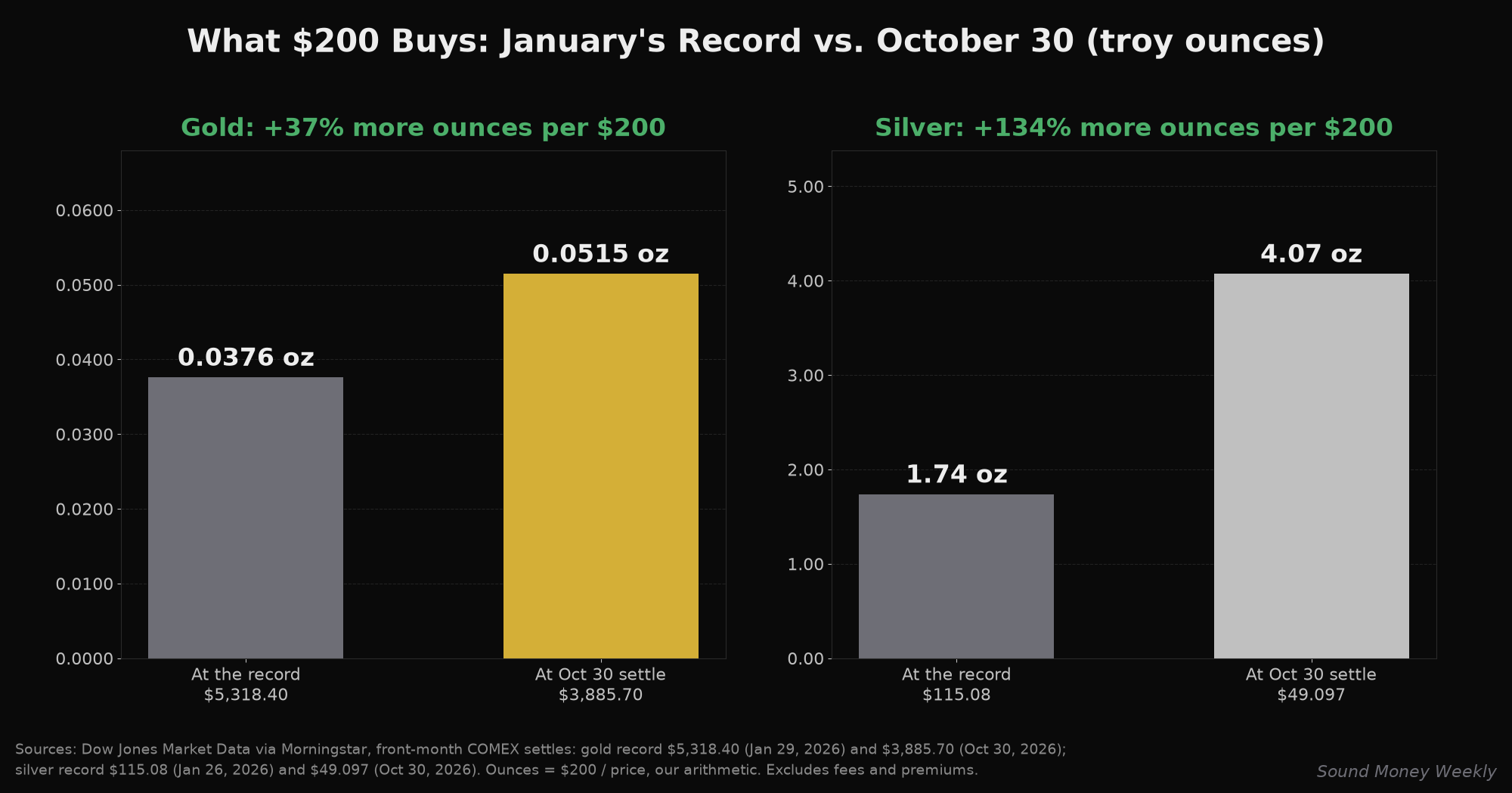
- At January's record settle, $200 bought 0.0376 oz of gold. At Friday's $3,885.70, it buys 0.0515 oz, about 37% more ounces for the same money.
- On silver, $200 bought 1.74 oz at the $115.08 record and buys 4.07 oz at $49.097, about 134% more.
- A year of $200 monthly purchases at Friday's gold price would accumulate about 0.62 oz (our arithmetic, before fees).
None of that requires a forecast. A steady buyer's ounces pile up month after month, and the structure they sit in is a decision made once and checked now and then. This week was a good reminder to check.
Quick Glossary
- Tokenized gold: a digital token that represents a set amount of physical gold, such as one troy ounce per PAXG.
- Stablecoin / USDC: a token designed to hold a steady value. USDC is built to stay worth one US dollar.
- MiCA: the EU's crypto rulebook, covering who may issue tokens and which platforms may offer them.
- ESMA: the European Securities and Markets Authority, the EU's securities regulator.
- Allocated gold: gold tied to specific bars with serial numbers, like a safe deposit box with your name on it.
- Unallocated gold: a claim on an account provider for a quantity of gold, more like a bank balance.
- Spread: the gap between the price to buy and the price to sell.
- Hot wallet: an internet-connected wallet an exchange uses for everyday payouts.
- Front-month: the futures contract closest to expiring, usually the one quoted as "the price" of gold.
- Troy ounce: the standard unit for precious metals, about 31.1 grams.
What We're Watching
- US midterms, Tuesday, November 3. Kitco's analysts flagged election risk alongside Iran headlines as the week's main wildcard.
- October payrolls, Friday, November 6. December hike odds were about 83% after the Fed's hold for the December 8-9 meeting. A weak jobs print is the clearest thing that could reprice them.
- WGC Q3 Gold Demand Trends. The World Gold Council has said early November. It will show how central bank, bar-and-coin and jewellery demand held up in the third quarter, before October's slide.
- ESMA's January deadline. Watch whether other EU-licensed platforms follow Coinbase on PAXG, and whether any gold token issuer seeks MiCA authorization.
- The FCA's next step after its consultation closed October 23.
- Diwali, November 8. India's jewellers were holding back ahead of the festival. Post-Diwali import data will show how much demand was deferred.
We will be back next Monday with the post-payrolls read.
This week's story comes down to one question: who stands between you and your gold? At Sound Money, metal you buy doesn't stay on our books. Once it's sold, it's delivered to VaultMax and held there on your behalf as allocated physical gold. What happens to it next is your decision, not ours: request physical delivery, or sell it back to Sound Money whenever you choose. Sound Money exists to make consistent precious metals accumulation accessible. You can learn more at sound.money.
Disclaimer: This content is provided by Sound Money for educational and informational purposes only. Nothing published here constitutes investment advice, financial advice, trading advice, or any other form of professional advice. Sound Money is not a registered investment advisor, broker-dealer, or financial planner. The information presented reflects our analysis of publicly available data and should not be relied upon as a basis for investment decisions. Precious metals investments carry risk, including the potential loss of principal. Past performance does not guarantee future results. Always consult a qualified financial advisor before making investment decisions. For more information about Sound Money's products and services, visit sound.money.
- gold
- precious-metals
- tokenized-gold
- custody
- allocated-gold
- mica
- silver