Fake Gold That Passes the Acid Test: Inside 'Gold Powder'
Indian jewelers say a 'gold powder' of platinum-group metals beats acid and touchstone tests. We check the claims and explain how fake gold gets caught.
A jewelry artisan in Indore, a city in central India with a historic bullion bazaar, takes a gold bar from a supplier and melts it down to make jewelry. The bar looked right. It weighed right. It passed the acid test. But when the gold was melted, it turned black in places, and less gold came out than went in.
That complaint, and others like it, led the Indore Silver, Gold and Jewelry Traders Association to call an emergency meeting on Monday, November 2. Traders told reporters that suppliers are mixing a fine metal powder, known in the market as "Gold Powder", into gold, and that it beats the acid and touchstone tests jewelers have used for centuries.
It sounds like a heist movie. The real fake gold story is better: the trick is decades old, the most-repeated explanation for it is partly wrong, and the economics behind it have flipped. Underneath sits a question every gold owner should be able to answer: how do you know what is in your gold?
The Story
What Indore reported
Hindi-language papers carried it first: Dainik Jagran reported it on November 3; Mint picked it up in English on November 4. According to traders quoted in those reports:
- Complaints about gold mixed with ruthenium, iridium and osmium have surfaced over the past two to three years.
- The powder reportedly enters the market through Maharashtra and West Bengal. Some suspect it is made in China, though Mint notes its origin "has not been independently established."
- The adulterated gold is reportedly offered at about 10% below the going gold rate.
Dainik Bhaskar, a separate Hindi daily, interviewed association executive member Avinash Shastri. In its account, wholesalers and artisans complained that "some kind of powder" (our translation) had been mixed into gold, which darkened when heated. Shastri said the association does not yet know where the powder came from. Navpradesh quoted Shastri saying the association would now recognize trade only in gold of 99.50% purity and would pursue legal action and trading bans against anyone found supplying adulterated metal.
Note what is missing. As of Sunday, we found no published lab analysis of the Indore material, no police case, and no statement from the Bureau of Indian Standards (BIS, India's national standards body, which runs gold hallmarking). The specific metals named are what traders say, not what a lab has confirmed.
This trick has a history
Mixing platinum-group metals (PGMs, the family of six heavy, rare metals that includes platinum, iridium, ruthenium and osmium) into gold is not new.
- India, mid-2000s. In 2009, the Times of India quoted a BIS official saying some refineries were losing 50 to 60 grams per kilogram of gold bought from the market, and that "a blackish substance kept floating" in the acid used to dissolve it. The practice was "especially rampant between 2004 and 2006," and in 2006 BIS told hallmarking centers to recalibrate their testing machines to look for iridium and ruthenium.
- India, 2017. At a conference of the LBMA (the London Bullion Market Association, which sets the standards for the global wholesale gold market), the Indian refiner MMTC-PAMP said PGM adulteration of domestically refined gold and handmade jewelry in India's informal sector was "rampant", with a typical piece or bar containing "up to 2%" of the adulterant.
- China, 2013. China Central Television (CCTV) used its annual consumer-rights broadcast to show a workshop owner adding 0.97 grams of iridium powder to 47.55 grams of gold in under four minutes. A necklace sold as "pure gold" (99.9%) tested at 99.44%, with more than 0.14% iridium.
- South Korea, January 2026. The Korea Jewelry Federation warned of counterfeit gold containing impurities of up to 9%, including tungsten, which an industry official said was "nearly indistinguishable from gold using non-destructive methods such as X-rays."
The pattern repeats: when gold gets expensive, someone looks for a cheaper metal the everyday tests cannot tell apart from it.
Under the Hood
How the touchstone test works, and why PGMs pass it
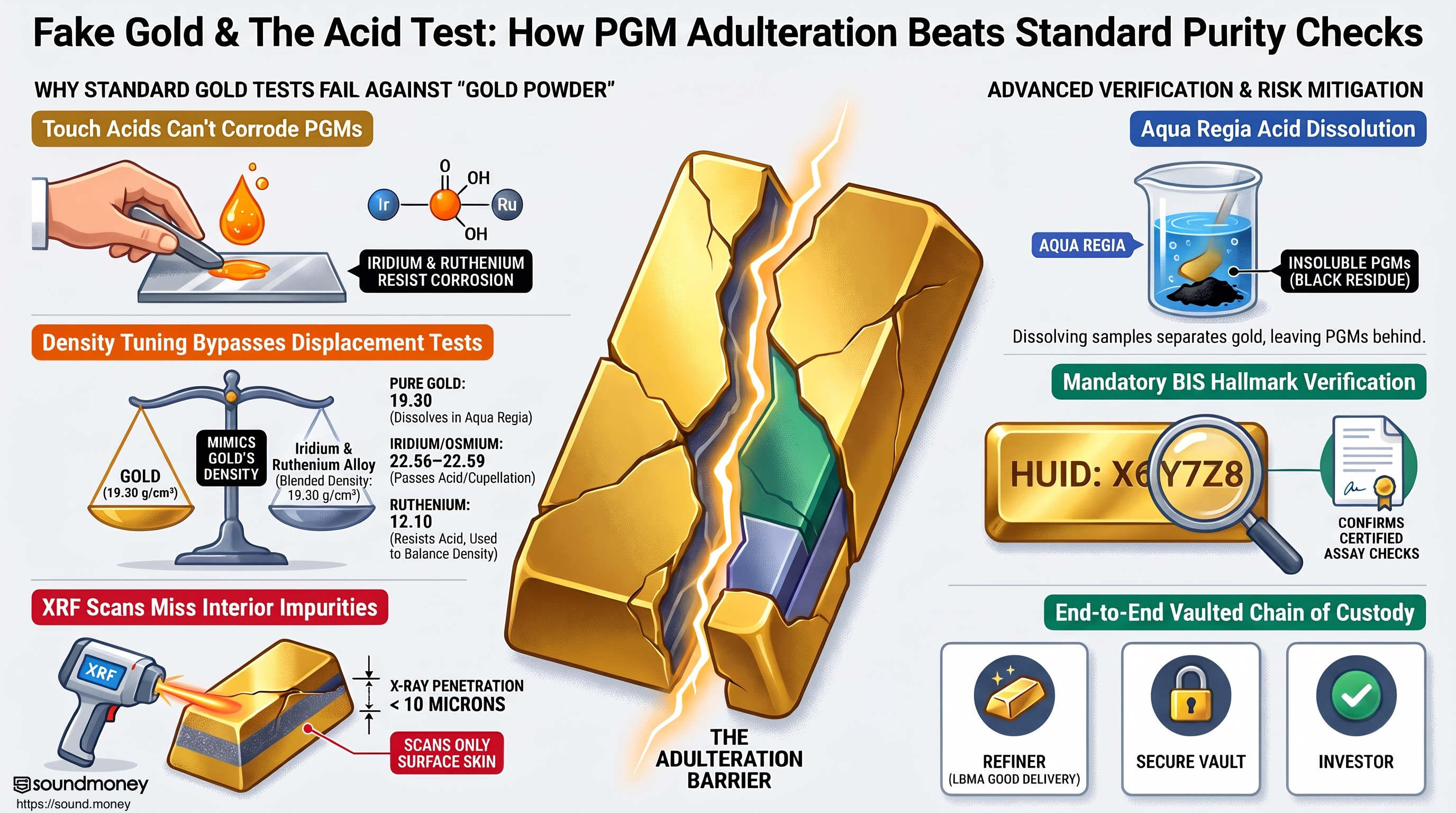
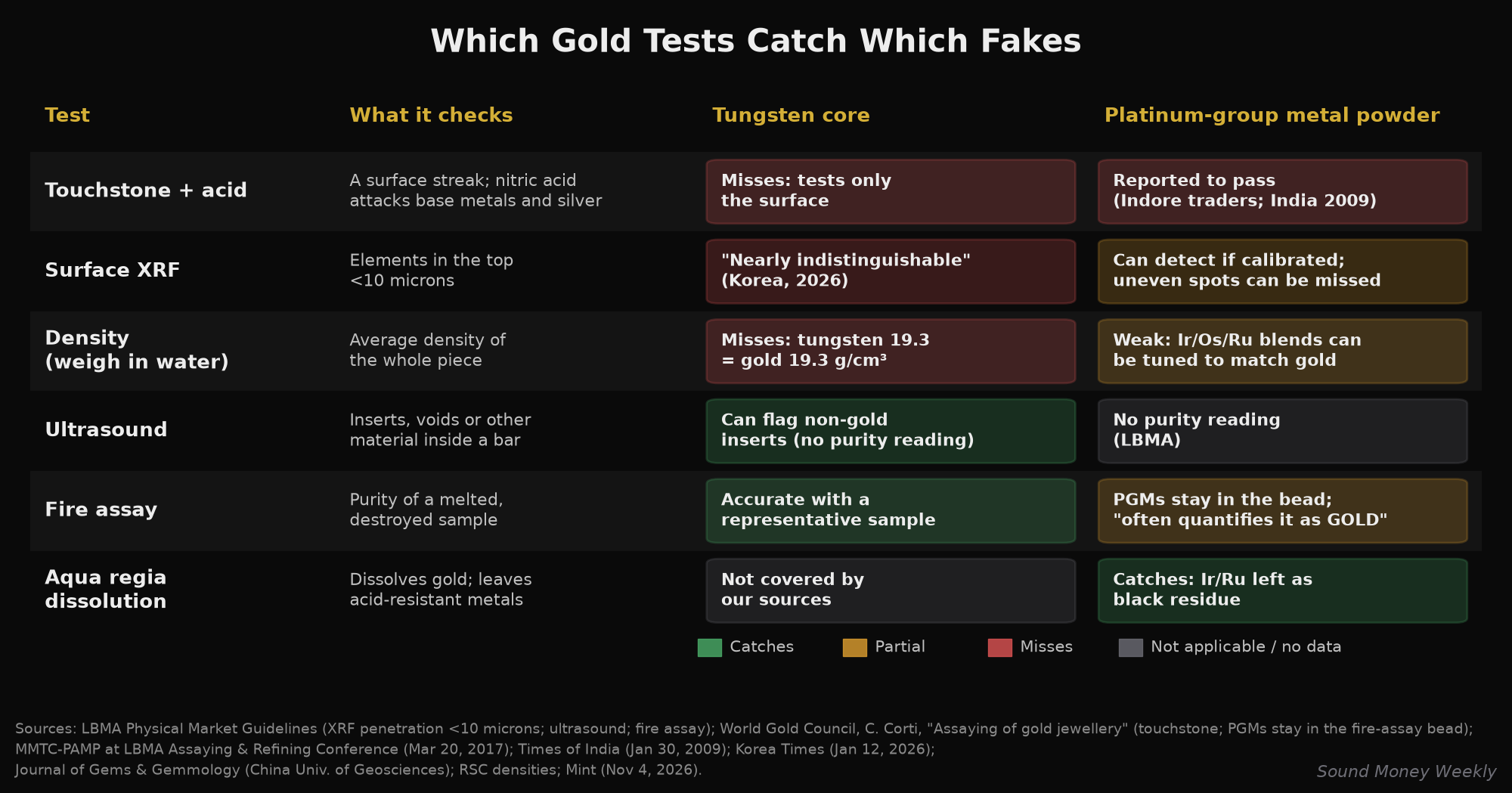
The touchstone is one of the oldest assay methods in the world. As a World Gold Council technical paper describes it, the tester rubs the item on a hard, slightly abrasive black stone to leave a streak, places streaks from reference alloys of known purity beside it, and applies "touch acids" based on nitric acid. The acid attacks base metals and silver; the more the streak darkens, the less gold it contains. The paper calls it "a subjective test."
That explains why platinum-group metals get through. The touch acids target copper and silver, and the Royal Society of Chemistry (RSC) calls iridium "the most corrosion-resistant material known". A test built to catch metals that corrode cannot see one that doesn't, and it only ever tests a streak from the surface.
The density claim we had to correct
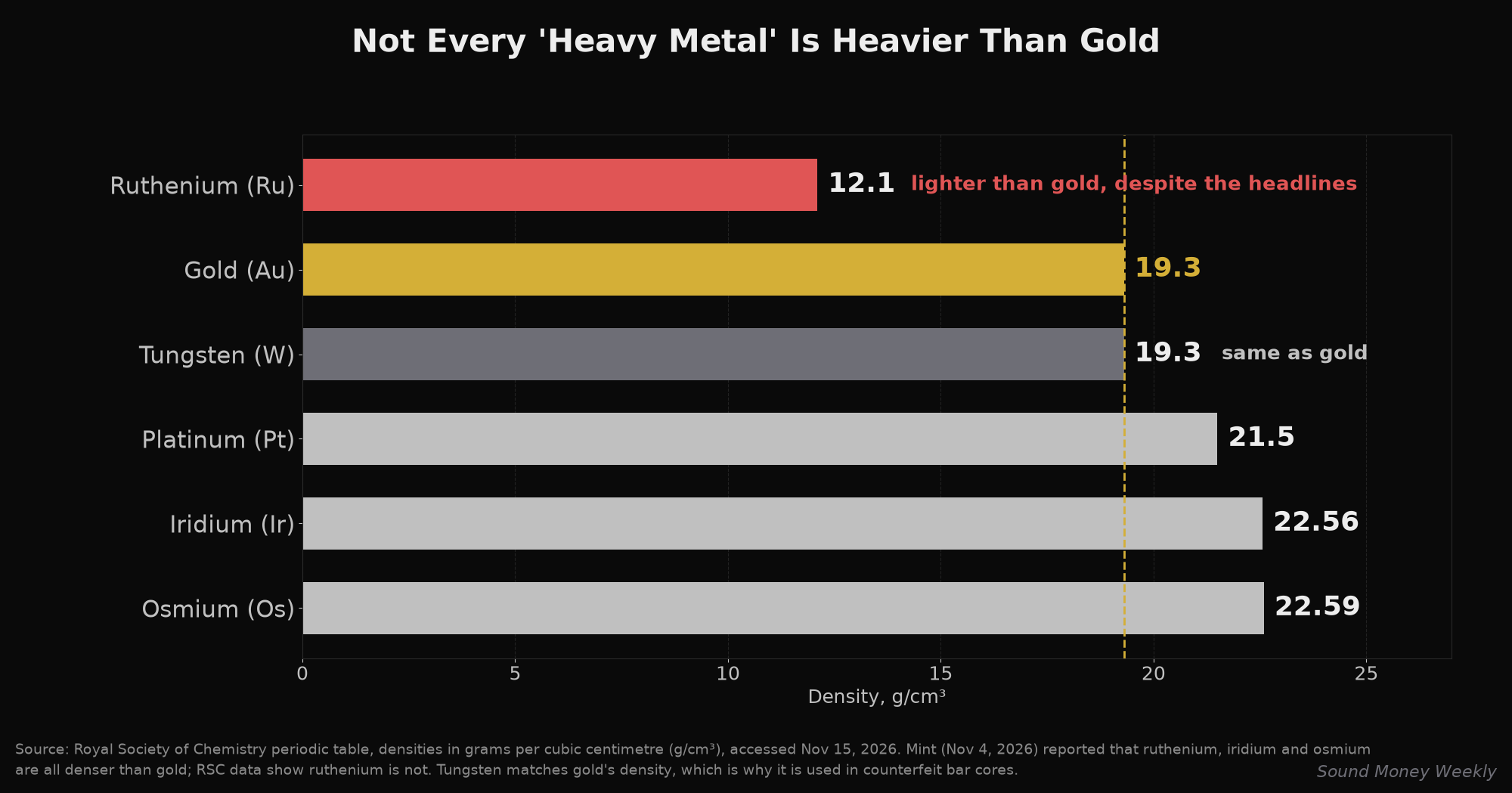
Most coverage repeats Mint's line that ruthenium, iridium and osmium "have a higher density than gold," so a little powder adds a lot of weight. Two of the three are denser. Ruthenium is not. RSC data put gold at 19.3 grams per cubic centimeter, iridium at 22.56 and osmium at 22.59, but ruthenium at just 12.1.
Density matters because of a classic check: weigh the item in air, then in water. A blend of heavy and light PGMs can be tuned to pass it. A Chinese study of iridium-doped jewelry found the added material was mostly iridium, osmium and ruthenium, in roughly a 65–70 to 30–35 split, with a density "consistent with" gold. And tungsten (19.3) matches gold almost exactly on its own, which is why it keeps turning up in counterfeit gold like the Korean cases.
Why the machines miss it too
The modern answer is X-ray fluorescence (XRF), a machine that fires X-rays at the metal and reads which elements respond. It is fast, but the LBMA warns that in gold, X-rays penetrate "generally, less than 10 microns", far thinner than a human hair. XRF reads the skin of an object, not its heart. And MMTC-PAMP found PGM particles stay dispersed rather than alloying, so a spot reading can land on clean gold. MMTC-PAMP also notes that newer XRF detectors separate iridium's signal from gold's far better than older ones, and the machine has to be calibrated to look for PGMs at all, which is why BIS ordered recalibration back in 2006.
The fire assay paradox
Fire assay is the gold standard of gold testing. A sample is melted with lead and silver in a small porous dish called a cupel, the base metals are burned off, and what remains is weighed. The LBMA calls a representative sample analyzed by fire assay "the only way to accurately determine the fineness" (purity) of a gold bar.
Here is the twist. The bead left after cupellation also retains "any platinum group metals present", according to the World Gold Council paper. MMTC-PAMP put it bluntly: cupellation "often quantifies it as GOLD." Skilled chemists can spot tiny black particles in the result, and the fix is to dissolve the sample in aqua regia (a mix of nitric and hydrochloric acids that dissolves gold). Gold goes into solution; iridium and ruthenium do not, and are left behind as black residue that can be filtered out.
A neat bit of history: iridium and osmium were discovered in 1803 when a London chemist dissolved crude platinum in aqua regia and found a black residue. Two centuries later, refiners hunt for the same black residue to catch fake gold.
The price puzzle nobody mentions
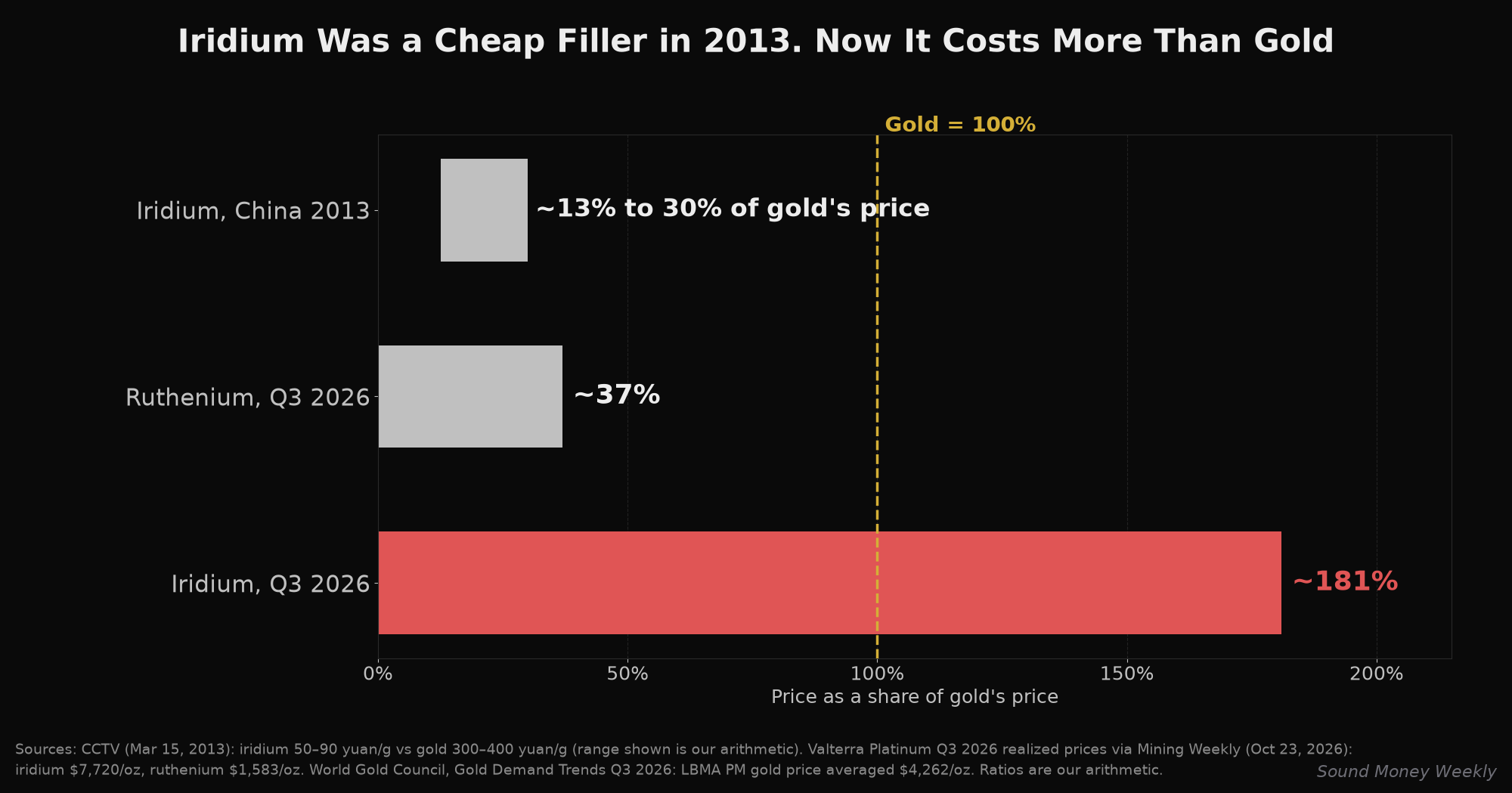
In 2013, CCTV reported iridium selling for 50 to 90 yuan per gram against 300 to 400 yuan for gold, roughly 13% to 30% of gold's price by our arithmetic. At that discount, swapping gold for iridium was simple fraud arithmetic.
That is no longer true. In the third quarter of 2026, South African miner Valterra Platinum realized $7,720 an ounce for iridium and $1,583 for ruthenium, while gold averaged $4,262 on the LBMA afternoon price. By our arithmetic, iridium now costs about 1.8 times as much as gold, and ruthenium about 37% of gold's price.
So a fraudster mixing real iridium into gold today would be adding metal worth more than the gold it replaces. If the Indore powder contains PGMs, it likely leans on ruthenium (cheaper, but light and easier to catch by density) or on cheaper fillers nobody has named. Without a published lab report, we cannot say which.
The skeptic's case
A fair skeptic would say this is one market's word-of-mouth, with no lab result and no arrest. That is right, which is why we present the Indore details as reported, not proven. A skeptic might also say adulteration at 1–2% is a rounding error. It isn't for a jeweler buying by the kilogram. At Friday's COMEX settle of $3,879.70, 2% of a kilogram is about $2,500 of missing gold (our arithmetic). Even so, scale it fairly: these cases cluster in scrap, handmade jewelry and locally refined bars, though China's 2013 case did reach branded jewelry counters. They are not evidence that the global bullion system is compromised.
What It Means
Let's translate this into plain English.
Gold risk comes in tiers. At one end are bars from refiners on the LBMA's Good Delivery list (refiners whose bars the London market accepts), assayed at the source and held in professional vaults with an unbroken chain of custody. At the other are scrap, unbranded bars and jewelry that change hands many times, checked on a stone or a quick scan. The LBMA itself says there is no definitive non-destructive test, and that "the best risk mitigation of sub-standard assay remains the Good Delivery eco-system of refineries and chain of custody." No tier is perfectly immune, but the risks are very different: knowing where gold has been protects you more than testing it after the fact.
For jewelry buyers in India, the hallmark is the first line of defense. Hallmarking is mandatory in 398 districts after six more were added this month. Each hallmarked piece carries a six-character HUID (Hallmark Unique Identification) code that buyers can check in the BIS Care app, and BIS's hallmarking process combines XRF screening with sampling and fire assay. Note the gaps: gold bullion and items under 2 grams are exempt, and Indore's complaints concerned bars traded between wholesalers and artisans.
For gold itself, fraud at the edges of the market says nothing about the price. If anything, it shows gold is valuable enough to be worth faking.
For the DCA investor (dollar-cost averaging, buying a fixed dollar amount on a schedule), the lesson is about what you own, not when you buy. At Friday's front-month COMEX settle of $3,879.70, down 4.55% for the week according to Dow Jones Market Data, $200 buys about 0.0516 oz of gold. (COMEX is the New York futures exchange where much of the world's gold price is set; ounces are our arithmetic.) A steady schedule does its work only if every one of those ounces is real.
What We're Watching
- A lab result from Indore. The first published analysis of the "gold powder" will show whether it really is ruthenium, iridium and osmium, or something cheaper.
- BIS and the police. Any statement from BIS, or a case filed by police or India's Directorate of Revenue Intelligence (DRI, its customs-fraud agency), would move this from trader reports to established fact.
- Wednesday, November 18: Fed minutes. The October FOMC minutes are due. The FOMC (Federal Open Market Committee) is the Fed's rate-setting group.
- December 8 to 9: the Fed decision. CME FedWatch (a tool from CME Group, which owns COMEX) implied roughly a 90% chance of a quarter-point hike after Friday's producer price data. Check the live number.
For more on the blind spots in gold's data, see our post on the 470 tonnes of gold nobody counted. We will be back next Monday.
This week's story comes down to one question: how sure are you of what is in your gold, and where it has been? At Sound Money, metal you buy is delivered to VaultMax and held there on your behalf as allocated physical gold, and you can request physical delivery or sell it back to Sound Money at any time. Sound Money exists to make consistent precious metals accumulation accessible. Learn more at sound.money.
Disclaimer: This content is provided by Sound Money for educational and informational purposes only. Nothing published here constitutes investment advice, financial advice, trading advice, or any other form of professional advice. Sound Money is not a registered investment advisor, broker-dealer, or financial planner. The information presented reflects our analysis of publicly available data and should not be relied upon as a basis for investment decisions. Precious metals investments carry risk, including the potential loss of principal. Past performance does not guarantee future results. Always consult a qualified financial advisor before making investment decisions. For more information about Sound Money's products and services, visit sound.money.
- gold
- precious-metals
- fake-gold
- gold-adulteration
- india
- gold-testing
- hallmarking
- platinum-group-metals