289 Tonnes. Q2 Record. Korea Buys Gold for the First Time Since 2013.
Central banks set a Q2 record with 289 tonnes of gold purchases. Korea ended a 13-year absence. Warsh held with three dissenters. Here's the full read.
Every quarter, the World Gold Council publishes the definitive accounting of global gold demand. The Q2 2026 edition, released July 30, landed with a number that stands on its own: 289 tonnes.
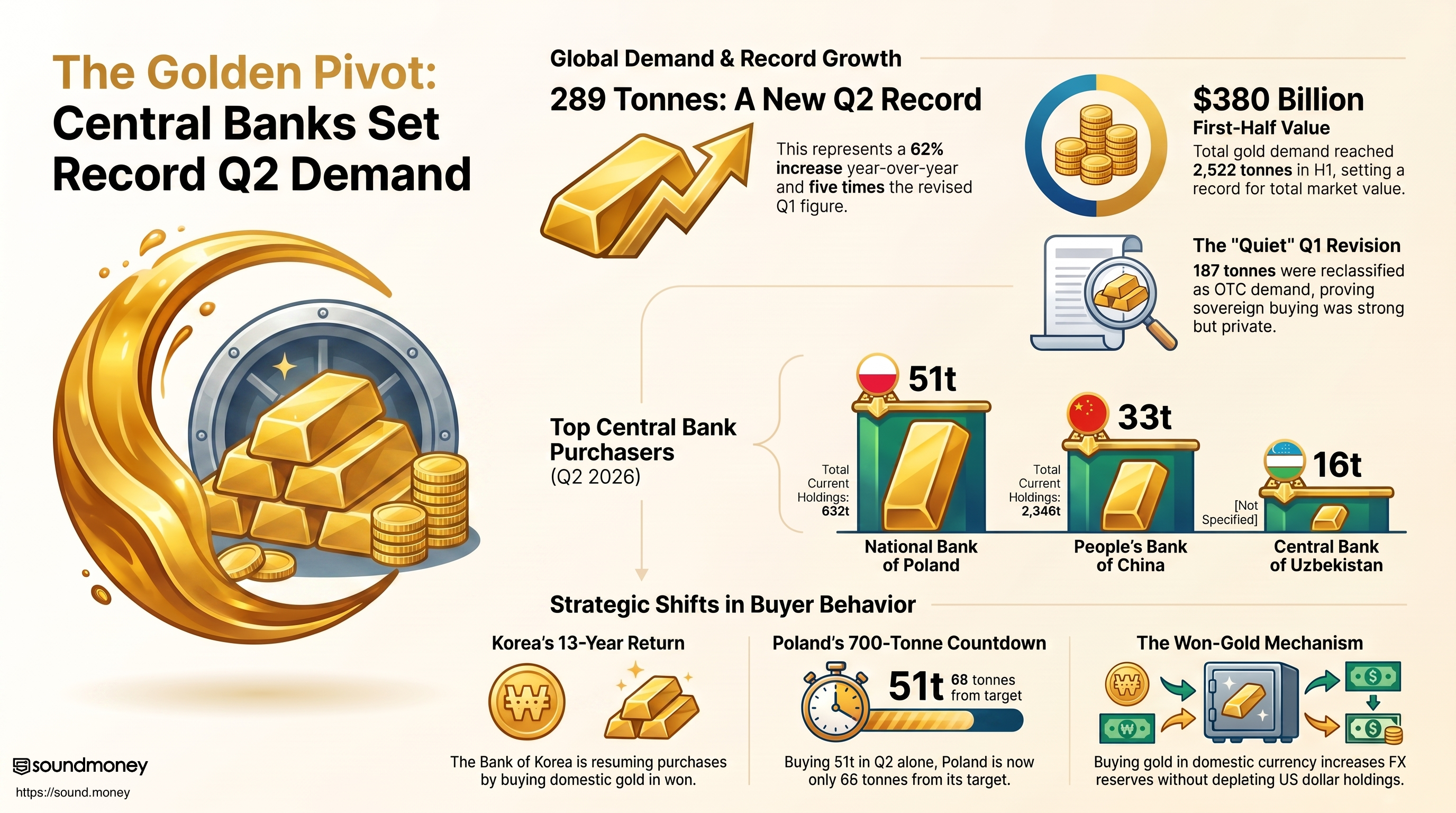
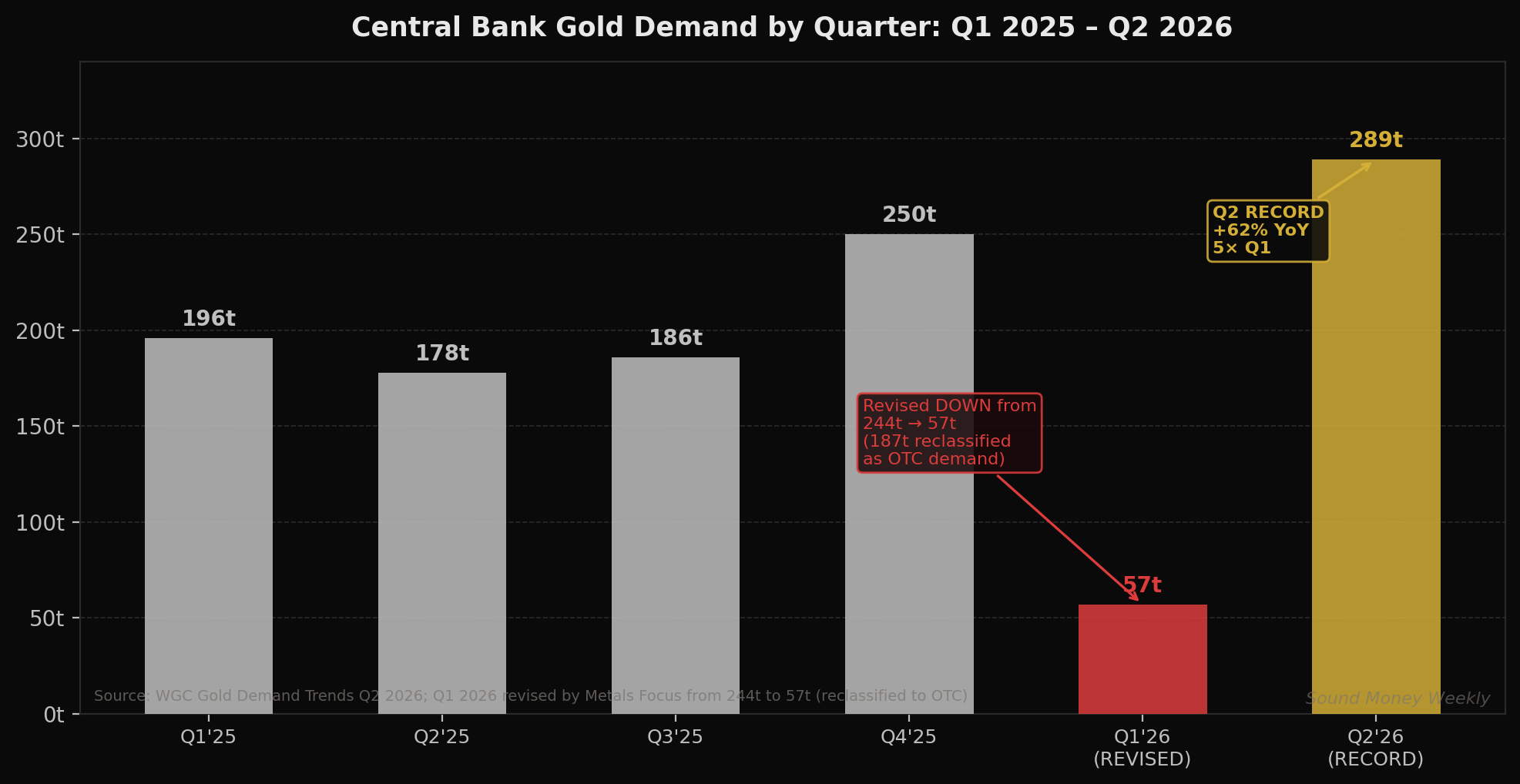
That is the largest central bank gold purchase for any second quarter on record — a 62% increase versus Q2 2025, and more than five times the revised first-quarter figure. The same report confirmed something that will take years to fully register in financial markets: the buyer list keeps getting longer.
This week also brought Warsh's second FOMC meeting — a 9-3 hold with the three dissenters all voting to hike immediately — and, on Monday, the Bank of Korea's announcement that it is resuming gold purchases after a 13-year absence. The week's three stories are connected in ways that matter for every gold investor.
The WGC Q2 Report: What 289 Tonnes Actually Means
The WGC's Gold Demand Trends Q2 2026 report documents all sources of gold demand across jewelry, technology, investment, and central banks. The Q2 central bank headline is stark: 289 tonnes, the highest second-quarter total in the data series.
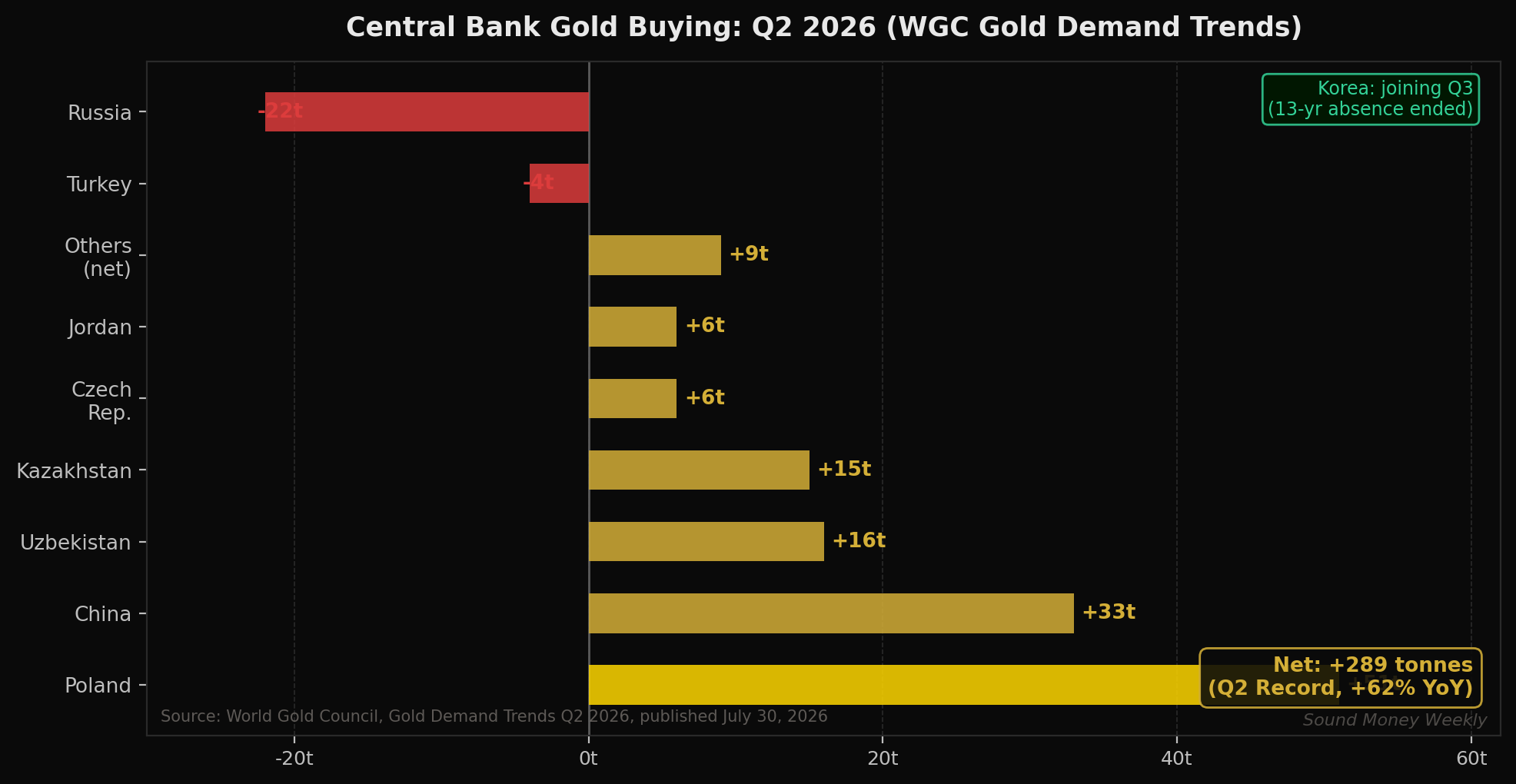
Poland dominated. The National Bank of Poland added 51 tonnes in Q2 alone, bringing its H1 total to 82 tonnes and its total reserves to 632 tonnes. Poland has set a formal target of 700 tonnes. It is now 68 tonnes away, buying at a pace that suggests it reaches that target before year-end.
China accelerated. The People's Bank of China added 33 tonnes in Q2 — its largest quarterly purchase since Q4 2023, bringing its total holdings to 2,346 tonnes. The PBOC has now bought gold for 21 consecutive months.
The full buyer list: Uzbekistan added 16t, Kazakhstan 15t, the Czech Republic 6t, Jordan 6t. Russia sold 22 tonnes to plug a budget deficit; Turkey sold 4 tonnes.
Total gold demand — including OTC transactions — held flat at 1,269 tonnes in Q2. First-half demand reached 2,522 tonnes, worth a record $380 billion. ETF demand was a net negative in Q2 (-45t outflows from Western funds as higher rates weighed on sentiment), partially offset by strong OTC investment of 327 tonnes, driven primarily by Asian buyers.
The Revision You Should Know About
Here is a number that barely made headlines: the WGC revised Q1 2026 central bank demand from 244 tonnes down to 57 tonnes.
A reduction of 187 tonnes — the equivalent of nearly two months of Q2 buying — was reclassified from "official central bank" demand into "OTC and other" demand by Metals Focus, the research firm that compiles the underlying data.
What does that mean practically? The gold was still bought. Sovereign entities were still acquiring it in Q1. But the channel was the over-the-counter market — direct bilateral transactions between counterparties, often without public reporting. OTC buying is real physical demand. It just doesn't show up in official reserve statistics until central banks choose to report it.
The implication: Q1's "disappointingly weak" CB demand of 57 tonnes was accompanied by 187 tonnes of sovereign OTC buying that wasn't officially categorized as central bank demand. Add them together and Q1 2026 was not weak at all — it was just quiet.
Korea's 13-Year Return: A Mechanism Most People Don't Know
On Monday morning, the Bank of Korea announced it is resuming gold purchases — ending a hiatus that began in February 2013.
The BOK's approach has two tracks. The first is gold ETF purchases, which the bank already began in Q2 2026 on a small scale. ETFs are classified as securities in reserve accounting, not gold, so they won't appear in Korea's official gold holdings.
The second track — physical gold — works through a mechanism almost nobody is discussing: Korea will buy gold in South Korean won, directly from domestic gold refiners (LS MnM and Korea Zinc), purchasing metal that was originally destined for export.
Here is why this matters structurally: when a central bank buys gold using its own currency, it doesn't spend its foreign exchange reserves — it adds to them. The Bank of Korea spends won, receives gold bars, and the gold counts as foreign exchange reserves. The reserve total goes up, not down. This is categorically different from buying gold on the London Bullion Market by selling dollars, which depletes FX reserves to add gold.
The BOK explicitly cited this advantage: "By purchasing gold in won, instead of using the bank's existing dollar reserves, the Bank of Korea can effectively increase its foreign exchange reserves." That is a significant statement about the institutional logic of gold accumulation in 2026.
The scale will be gradual — the bank will only purchase when manufacturers request it and prices are favorable. But the precedent matters. South Korea is Asia's fourth-largest economy. Its central bank was absent from gold buying for 13 years. It just came back.
Warsh's Three Dissenters
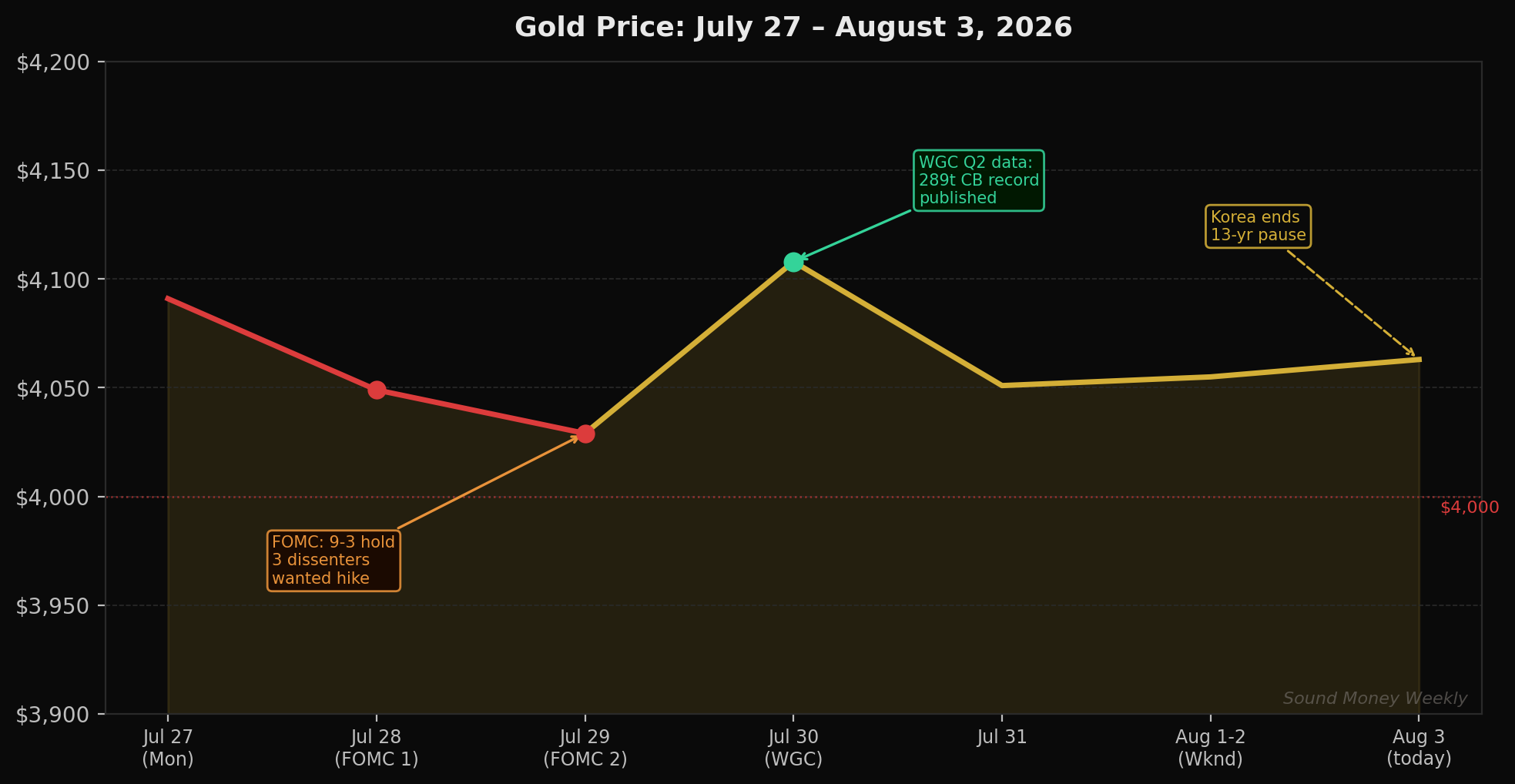
The FOMC voted 9-3 on July 29 to hold the federal funds rate at 3.50-3.75%. The three dissenting votes — Hammack, Kashkari, and Logan — all preferred an immediate 25-basis-point hike.
That is not a footnote. Twenty-five percent of the FOMC's voting members believe the current rate is already too low. The dissents were not explained in the statement (Warsh has removed that Powell-era practice), but the market interpreted them clearly: three regional Fed presidents were willing to go on record favoring a hike that Warsh himself declined to deliver.
Warsh's press conference reiterated the 2% mandate with unusual directness: "There is no soft inflation target, there is no soft implicit target — not on this Committee's watch. There is only a target, and it is 2%." He welcomed the rise in long-term Treasury yields since the June meeting — noting they reflected "economic data and less response to monetary policy" — calling this a "change for the better." The Fed is letting the bond market do some of the work.
The FOMC statement was 166 words — still dramatically shorter than Powell's 313-word average. No forward guidance. The policy-relevant phrase remained: "The Committee will deliver price stability."
After the statement, September hike probability settled at approximately 57-65% depending on the source. PNC Economics noted an 80% probability of at least one hike by year-end. The market is pricing a hike — the question is when.
What This Week Means for the DCA Investor
The WGC's Q2 report contains a sentence worth reading slowly: "[Gold demand] was flat year-on-year at 1,269 tonnes, as the gold price eased from the record highs seen at the start of 2026." Gold demand held at 1,269 tonnes in a quarter when gold averaged $4,506/oz — still 37% above Q2 2025's price level — and demand didn't flinch.
When price doubles and demand holds, that is a structural statement about the nature of the buyers. Central banks don't time-optimize. They accumulate toward strategic targets. Korea doesn't buy gold because it's at a good price — it buys because it has decided gold should be a larger proportion of its reserves. Poland is buying its way to 700 tonnes regardless of whether spot is $4,063 or $4,800.
At $4,063 today:
- $200/month buys 0.04922 oz — still 38.0% more metal per dollar than January's $5,608 ATH
- Over 12 months: 0.5907 oz accumulated on $2,400 invested
- At Goldman's year-end $4,900 target: worth $2,895 — a +20.6% return on monthly contributions
The structural demand that just set a Q2 record is accumulating at prices similar to today's. The question of when gold recovers from this year's pullback is a timing question. The question of who's accumulating is already answered in the WGC data.
What We're Watching
July Jobs Report — This Friday (August 7)
The most watched data point of the coming week. A strong jobs report strengthens the September hike case; a weak report softens it. The September FOMC on September 15-16 is the most live meeting in years. What the jobs and CPI data say between now and then will define what Warsh actually does.
July CPI — August 12
Oil's reversal (down 6% today after Trump delayed the Iran strike) may push July's energy CPI negative again — echoing June's disinflationary print. If July CPI follows June's pattern (3.5% or lower), September hike probability drops materially and gold's primary headwind softens significantly.
Korea's First Purchases
The timing of Korea's physical gold buying is event-driven: purchases occur when domestic gold refiners request transactions and the BOK decides to proceed. Watch for announcements from LS MnM and Korea Zinc about production and export allocations.
Poland's 700-Tonne Countdown
At 632 tonnes with 68t to go, and buying at 51t per quarter, Poland could reach its target as early as Q4 2026. When major buyers reach their stated targets, markets typically notice. It will be worth watching whether Poland announces an upward revision of its target — which would not be unprecedented — or reduces buying pace on approach.
WGC June CB Data (~August 6)
The monthly WGC data for June — the month gold fell 11.65% — will show whether central banks, including the PBOC (confirmed at 15t), accelerated their buying during the price drop. If June data mirrors July's strong Q2 number, the "buying the dip" narrative has direct primary-source backing.
The Bottom Line
Three things happened this week. Central banks set a Q2 buying record at 289 tonnes — led by Poland with 51t in three months. The Bank of Korea ended a 13-year absence, using a mechanism that turns gold purchases into an FX reserve gain. And Warsh held rates with 25% of his committee voting to hike immediately.
The buyer list just got longer. The frequency of buying is accelerating. And Warsh's Fed — with three dissenters and an 80% probability of a year-end hike — is now the primary variable determining whether this recovery happens in September or January.
The structural demand is not the variable. The timing is.
This article is for informational purposes only and does not constitute investment advice. Past performance of gold and silver prices is not indicative of future results. Always conduct your own research and consult a qualified financial advisor before making investment decisions. Sound Money provides fractional precious metals ownership services — see sound.money for full terms and conditions.
- gold
- silver
- precious-metals
- central-banks
- wgc
- poland
- korea
- fomc
- warsh
- gold-demand