Record 45% of Central Banks Plan to Buy Gold. Warsh Just Made It $183 Cheaper.
Record 45% of central banks plan to buy gold. Warsh's hawkish FOMC then dropped gold to $4,161. Both developments signal the same thing for DCA investors.
Last week delivered the sharpest contradiction in gold's 2026 story — two data points that appear to be in conflict but are actually pointing at the same conclusion.
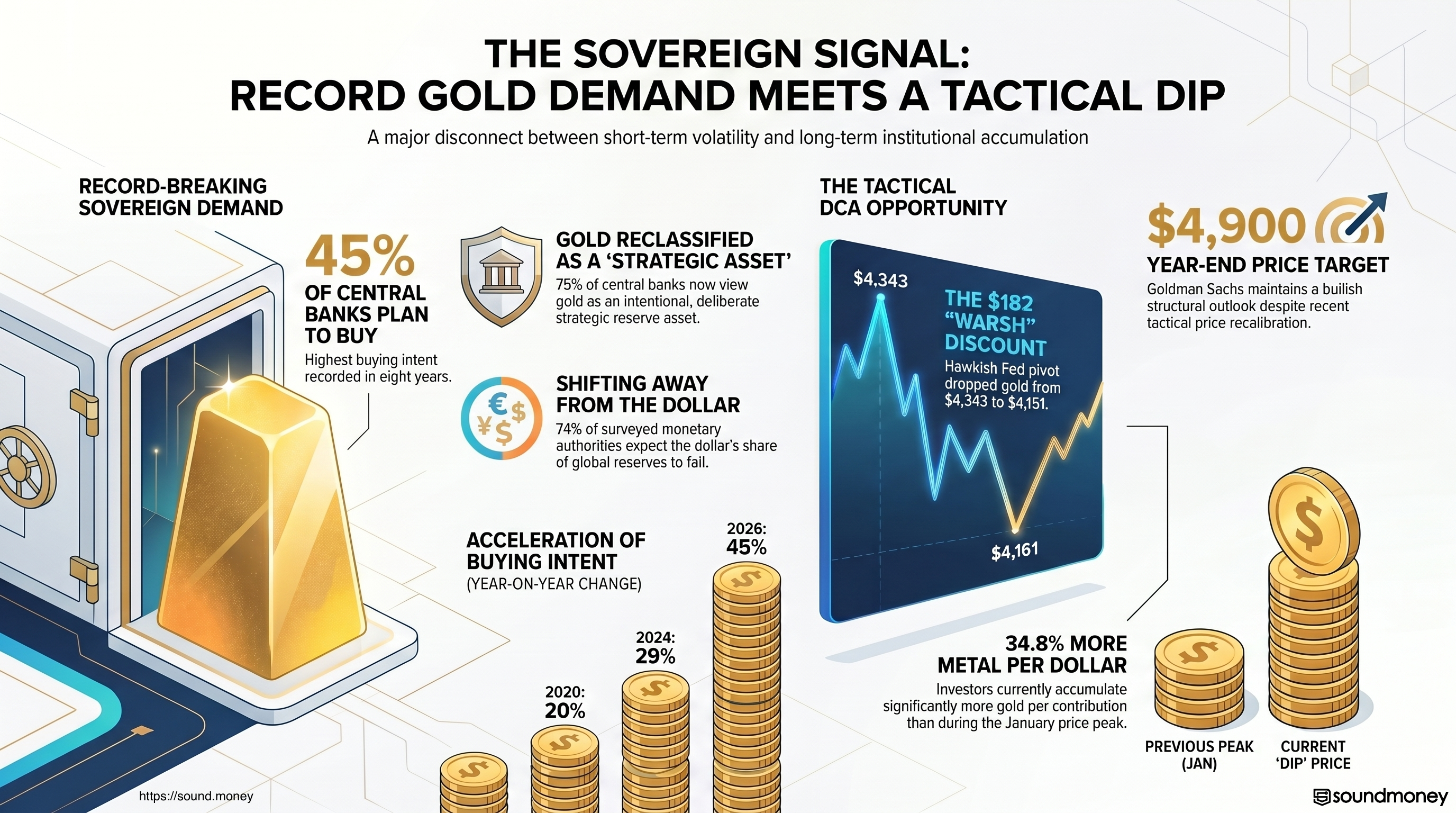
On Tuesday, the World Gold Council released its annual Central Bank Gold Reserves Survey: 45% of the 76 central banks surveyed plan to increase their gold holdings in the next 12 months — the highest reading since the survey began in 2018, and more than double the 20% recorded in 2020.
On Wednesday, Federal Reserve Chair Kevin Warsh held his first FOMC meeting — and delivered a hawkish shock that wiped $182 off the gold price in four trading days. Gold went from $4,343 on Monday to $4,161 today.
If you're a DCA investor, both of those things happened for you, not to you.
What Warsh Did — and What It Means
The rate decision was never the story. Markets had priced a 97% probability of a hold, and they got one. The federal funds rate stays at 3.50-3.75% for the fourth consecutive meeting.
What Warsh actually did was more significant: he rewrote the script.
The post-meeting statement shrank from 400 words to 130 — the shortest in modern Fed history. All forward guidance was removed. The previous easing bias ("the committee will adjust policy as appropriate") was deleted entirely. The statement closed with one sentence: a commitment to price stability. No mention of the employment mandate. That's not an accident; it's a deliberate choice.
The Summary of Economic Projections told the rest of the story: nine of eighteen FOMC members now project at least one rate hike in 2026. Core PCE inflation was revised up to 3.3% for 2026. The median year-end fed funds rate projection moved to 3.8% — implying one hike in the base case scenario. Notably, Warsh himself declined to submit a dot — a signal that he intends to eventually reform or retire the dot plot entirely.
Markets that had been pricing rate cuts adjusted fast. CME FedWatch now shows 87% probability of a rate hike by December, up from 61% before the FOMC. The dollar strengthened. The 2-year yield jumped 16 basis points. Gold fell.
Goldman's Recalibration
Two days after the FOMC, Goldman Sachs revised its year-end gold forecast — cutting by $500 to $4,900 per ounce, citing the hawkish Fed pivot and the resulting delay in rate cuts. Goldman now expects the first Fed cut in June 2027, pushed back from December 2026.
The analysts characterized their view as "structurally constructive but tactically cautious." They outlined a bear case: if Warsh actually follows through with aggressive hikes, gold could fall to $4,400 by December.
But here's what Goldman did not revise: their view that central bank demand and gold's reserve role are structurally intact. The tactical caution is about rates. The structural constructiveness is about everything else.
The WGC Survey: The Most Bullish Data in the Report's History
The World Gold Council surveyed 76 central banks between February and May 2026 — the largest respondent pool in the survey's eight-year history. The findings are unambiguous.
45% of central banks plan to increase their gold holdings in the next 12 months. That is a record high — up from 43% in 2025, 29% in 2024, and just 10% when the survey began in 2018. For comparison, only 1% of respondents plan to reduce their holdings.
89% expect global central bank gold reserves to continue increasing over the next year. That is near-unanimous institutional consensus in favor of accumulation.
75% now classify gold as a "deliberate strategic asset" — up from 64% a year ago. The shift from gold-as-legacy-holding to gold-as-intentional-strategy is accelerating.
74% expect the dollar's share of global reserves to fall within five years. That is not fringe sentiment — it is the dominant view among the world's monetary authorities.
93% of respondents now hold gold, up from 81% a year earlier.
Central banks have purchased an average of approximately 1,000 tonnes of gold annually for the past four years — double the pace of the preceding decade. The WGC survey confirms that structural pace is not slowing.
The Part Nobody's Talking About: Where the Gold Is Going
Here is the detail that deserves more attention than it's getting.
The WGC survey asked central banks not just whether they're buying, but whether they're changing where they store what they own. The answers were striking: 9% of respondents increased their domestic gold storage last year — up from 5% the year before. Another 10% diversified their overseas storage locations — up from just 2% the prior year.
That's nearly a doubling of the share of central banks actively managing their gold's physical location. These aren't just buying decisions — they're trust decisions. When the Reserve Bank of India repatriated 104 tonnes of gold from London to domestic vaults in just six months, and when central banks across emerging markets are moving stored gold from the Federal Reserve Bank of New York and the Bank of England back to their own soil, they're expressing something the purchase data alone doesn't capture: they want the metal where they can reach it.
The institutions that hold the most gold in the traditional custodial system are the same institutions most actively working around it. That's not a small signal.
What It Means for the DCA Investor
Let's be direct about the tension here. Warsh's hawkish pivot is a genuine headwind for gold's spot price in the near term. If the Fed actually raises rates in September or December, gold will likely face additional pressure. Goldman's bear case at $4,400 is not impossible — it's Goldman's own scenario if tightening accelerates.
That headwind coexists with the structural tailwinds that have been building for four years and were confirmed at record levels last week: 45% of central banks actively adding, nearly a trillion dollars of annual buying demand, gold at 27% of global reserves and rising, and sovereign institutions moving metal home as a statement of where they expect the world to go.
Those structural forces don't get repriced by a hawkish FOMC press conference. The sovereign demand that is driving the WGC's record survey numbers is driven by reserve strategy that unfolds over years and decades, not by the CME FedWatch probability for December.
The DCA math at $4,161:
At today's price of $4,161, every $200 monthly contribution buys 0.04808 oz of gold.
For context:
- In January, at the all-time high of $5,608, that same $200 bought 0.03566 oz
- Today you are getting 34.8% more metal for the same dollar amount
- Over 12 months at $200/month, you accumulate 0.5770 oz at this price level
- Total invested: $2,400 over the year
- At Goldman's revised $4,900 target: your position is worth $2,827 — a +17.8% return on monthly contributions
That math works because the mechanism is working. Every dollar you deploy in a period of macro uncertainty is buying more of the thing that 45% of the world's central banks just said they plan to buy more of. You're buying alongside the institutional consensus at a discounted price.
What We're Watching
Warsh's Next Move: September FOMC
With 87% hike probability priced for December, the question shifts to whether Warsh signals in July or August that September is live. The next major data points — June CPI (due mid-July) and July jobs report — will either confirm or challenge the hawkish narrative. Warsh has explicitly said he won't pre-commit. Watch the data, not the guidance.
Gold's Technical Level: $4,100 Floor
LiteFinance and several other technical analysts have flagged $4,100 as the next support level if selling pressure continues. Below that, $4,000 is the psychologically significant round number. Goldman's bear case is $4,400 — which means even in their worst case, they're not assuming gold breaks $4,000. That floor is more crowded than the headlines suggest.
WGC April CB Buying Data (Due Soon)
The May CB buying data from the WGC will land roughly mid-July. With the survey showing record buying intent, actual purchase data from April and May will confirm or complicate the picture. Watch for Poland, China, and India as the headline buyers.
Silver's Spot: ~$65
Silver has been largely absent from the headlines this week — lagging gold's move. The gold-to-silver ratio has widened, which historically has preceded silver outperformance in the next recovery. Not a short-term call, but worth tracking for the next catalyst.
The Bottom Line
The World Gold Council's most bullish survey in eight years and the Federal Reserve's most hawkish meeting in years both happened in the same seven days. One took the price down. The other confirmed who's waiting at every lower level.
Gold at $4,161 is $182 cheaper than it was a week ago and $1,447 below its all-time high. The 45% of central banks who said they plan to add don't care what Warsh's dot plot says. They're adding because the world they're preparing for is one where physical gold inside their own borders is the strategic reserve asset — and no FOMC statement is going to revise that thesis.
This article is for informational purposes only and does not constitute investment advice. Past performance of gold and silver prices is not indicative of future results. Always conduct your own research and consult a qualified financial advisor before making investment decisions. Sound Money provides fractional precious metals ownership services — see sound.money for full terms and conditions.
- gold
- silver
- precious-metals
- central-banks
- federal-reserve
- fomc
- warsh
- wgc
- dollar-cost-averaging