Goldman's $600 Upgrade Meets Gold's 2-Month Low: What the Divergence Tells You
Goldman raised its 2026 gold target by $600 the same week gold hit a 2-month low. Here's why that divergence matters for DCA investors.
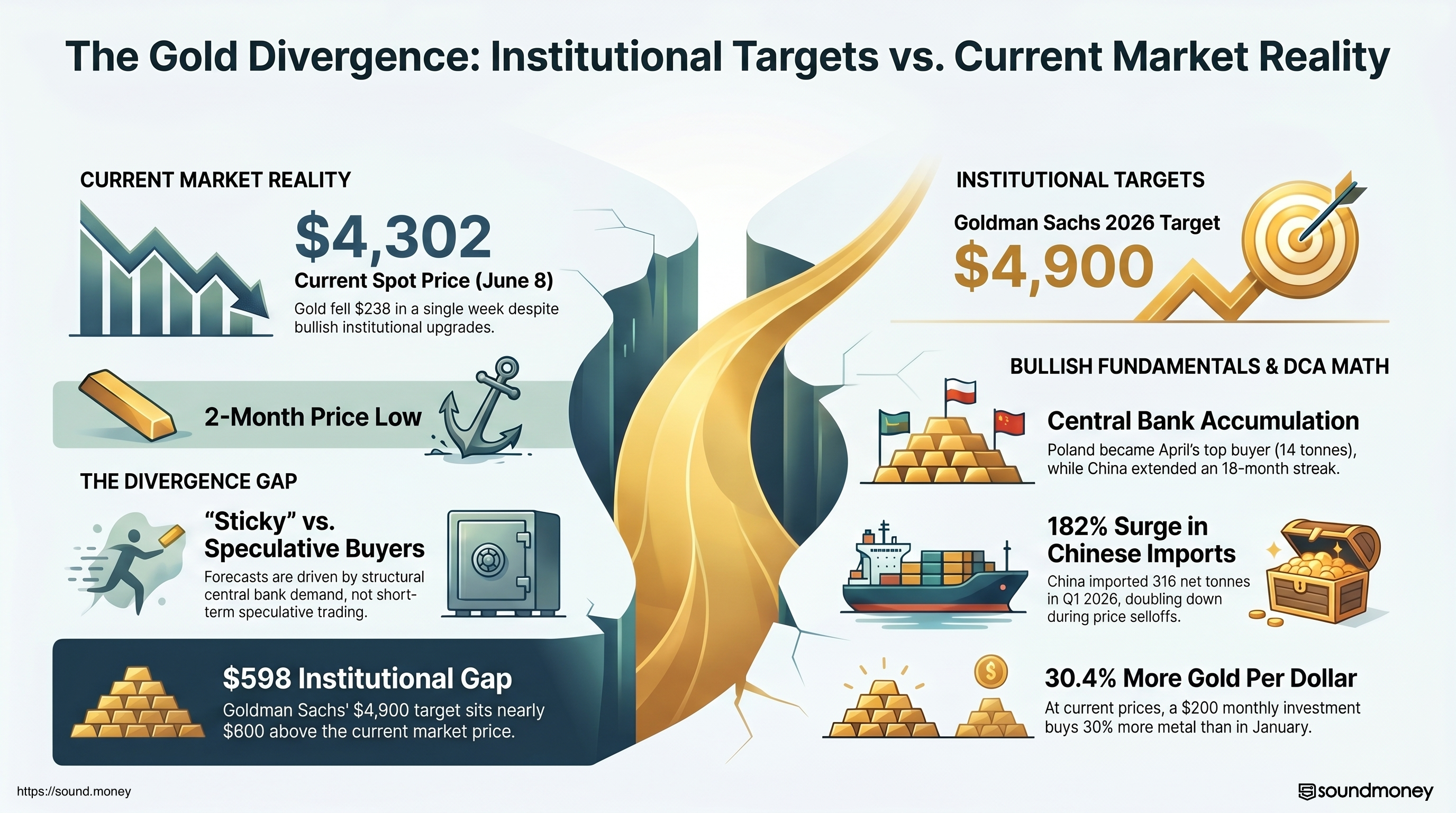
Sometimes the most important signal in a market is the gap between what the smartest money expects and what the price is doing right now. This week delivered one of those gaps on a silver platter.
On Thursday, Goldman Sachs raised its year-end 2026 gold forecast by $600 — from $4,300 to $4,900. By Monday morning, gold was trading at $4,302. That's a $598 gap between where one of the world's most sophisticated institutional forecasters thinks gold is going and where you can buy it right now.
That divergence isn't confusion. It's a setup.
What Happened This Week
Thursday, June 4 — The Upgrade
Goldman's commodities desk moved their year-end target from $4,300 to $4,900, citing two factors they consider "sticky": persistent central bank demand and accelerating Western ETF inflows. The phrase "sticky buyers" matters here — it's Goldman's signal that this isn't speculative froth. The demand underpinning their model is institutional and structural.
Friday, June 5 — The NFP Gut-punch
The May jobs report landed at 172,000 — well above expectations. The dollar surged. Gold fell roughly $30 in the immediate aftermath, dropping from ~$4,498 to ~$4,440. Silver took an even harder hit, falling 3.7% in a single session.
Here's the mechanism: a strong jobs number pushes back rate-cut expectations. Higher-for-longer rates mean a stronger dollar, which makes gold — priced in dollars — more expensive for global buyers and theoretically less attractive as a non-yielding asset. The market's reaction was textbook.
The Weekend — Geopolitical Wild Card
Over the weekend, Iran and Israel exchanged missile strikes, undermining the ceasefire framework that had been under construction. Normally, an Iran-Israel escalation is rocket fuel for gold. This time, the dollar's post-NFP strength and the prospect of higher oil prices feeding into rates kept gold under pressure. Brent crude moved toward $90-95. Gold fell another ~$140 over the weekend.
Monday, June 8 — $4,302
That's the current gold price as this publishes. A two-month low. Down roughly $238 from where it started the week. Goldman's $4,900 target is sitting $598 above the current bid.
Under the Hood
Central Banks: The Quiet Accumulation Continues
While the week's headlines fixated on jobs data and missile strikes, the World Gold Council published its April central bank data on June 3, and it contained a detail that almost nobody covered: Poland was April's single largest gold buyer, adding approximately 14 tonnes. China added 8 tonnes, extending what is now an 18-consecutive-month buying streak.
Poland buying more gold than China in a single month isn't trivia. Poland has been methodically pushing gold toward 30% of its total reserves — a threshold that signals strategic repositioning, not tactical trading. When a mid-sized European economy makes that kind of structural reserve shift, it's making a statement about its confidence in the dollar-based system.
The Numbers the Headlines Missed
Here's a gold import figure that should recalibrate how you think about demand: in Q1 2026, China imported 316 net tonnes of gold — up 182% from the prior quarter. To put a finer point on it: 143 of those tonnes were imported in March alone. March was the same month gold was in the middle of its deepest selloff of the year.
The largest gold importer on the planet was buying at maximum velocity during the period when Western investors were most skeptical. That's not a coincidence. It's a template.
Goldman's Forecast: What Changed
Goldman's model update isn't just a number revision — it's a thesis revision. Their previous $4,300 target was written under the assumption that ETF demand would remain tepid and central bank buying would moderate. Neither of those assumptions held. Western ETF inflows have accelerated, and the central bank buying pace from the WGC data has remained robust. When Goldman calls the buyers "sticky," they're saying these are holders, not traders — and holders don't respond to an NFP print by selling.
What the Divergence Tells You
Divergences between analyst targets and spot price almost always resolve in one direction — toward the target. The question is timing and volatility along the way.
The short-term pressure on gold is real: a strong dollar, higher rate-hike expectations post-NFP, and an Iran-Israel situation that could push oil higher (which feeds inflation, which feeds rate hawks). None of that is fake.
But the long-term forces Goldman is modeling are also real: 18 straight months of Chinese central bank buying, Poland at 30% reserves, Western ETF demand accelerating, and a geopolitical backdrop that keeps institutional hedging demand elevated. Those forces don't evaporate because a jobs report beats by 30,000.
The divergence is telling you that the short-term sellers and the long-term buyers are temporarily occupying the same price — and one of them is going to be right.
The Math Right Now
If you're on a monthly DCA program, June 8 is doing you a favor. Let's run the numbers.
At $4,302/oz:
- $200/month buys 0.04649 oz — approximately 30.4% more metal than you'd have purchased at January's all-time high of $5,608
- $200/month × 12 months = 0.558 oz accumulated over a year at this price level
- If Goldman's $4,900 target is reached by year-end, that 0.558 oz is worth $2,734 — a return of $334 on $2,400 invested, or roughly +14%
The math is simple, and it's why the phrase "more ounces per dollar" isn't just a tagline — it's the actual mechanics of what's happening in your position when gold pulls back.
Fractional ownership at whole-ounce pricing — the way Sound Money structures it — means you're not paying the 20–30% premiums that typically plague fractional physical purchases. Your DCA is working at the actual spot mechanism, not at a retail markup.
What We're Watching
June 10 — May CPI (Critical)
This is the data point that could flip the narrative fast. If May inflation comes in lower than expected — and there's a case for it, given the sharp retreat in oil prices through April and early May — rate-cut expectations could revive quickly. Gold's biggest headwind right now is the "higher for longer" thesis. One soft CPI print could cut that headwind in half.
June 10–11 — FOMC Meeting (Warsh's First)
Kevin Warsh chairs his first Federal Open Market Committee meeting this week. No one expects a rate cut. What the market is watching for is tone: does Warsh's first post-meeting statement signal that the bar for hikes has lowered? Any hawkish surprise would add pressure to gold. But markets have largely priced in a hold — the surprise risk is actually to the dovish side if CPI cooperates.
Iran-Israel
The ceasefire framework is under serious strain. Sustained escalation would eventually overcome the dollar-strength headwind for gold, but the sequence matters. Oil spikes first, inflation expectations rise, rate hawks respond — only then does geopolitical fear buying typically override the rate mechanism. Watch Brent crude as the leading indicator.
The Bottom Line
Goldman raised gold by $600 the same week the market knocked it down by $238. That kind of divergence doesn't resolve by the market agreeing with Goldman in a straight line — but it has historically resolved in the direction that the structural buyers are pointing.
Central banks in Poland, China, and dozens of other countries are not reading Friday's NFP report and reconsidering their reserve strategy. They're reading decades of reserve policy and quietly stacking. The month they move fastest tends to be the month spot price is most discouraging.
Every dollar you put into gold at $4,302 is buying you more metal than you've been able to acquire in months. The fundamentals that caused Goldman to revise upward by $600 haven't changed — only the price has.
This article is for informational purposes only and does not constitute investment advice. Past performance of gold and silver prices is not indicative of future results. Always conduct your own research and consult a qualified financial advisor before making investment decisions. Sound Money provides fractional precious metals ownership services — see sound.money for full terms.
- gold
- silver
- precious-metals
- central-banks
- goldman-sachs
- dollar-cost-averaging
- market-analysis