Gold vs Treasuries: Why Central Banks Are Buying Gold (2026 Outlook)
For the first time since 1996, central banks hold more gold than U.S. Treasuries. Explore what this shift means for gold prices, silver supply deficits, and the global economy in 2026.
Sound Money Weekly | March 19, 2026
The Hook
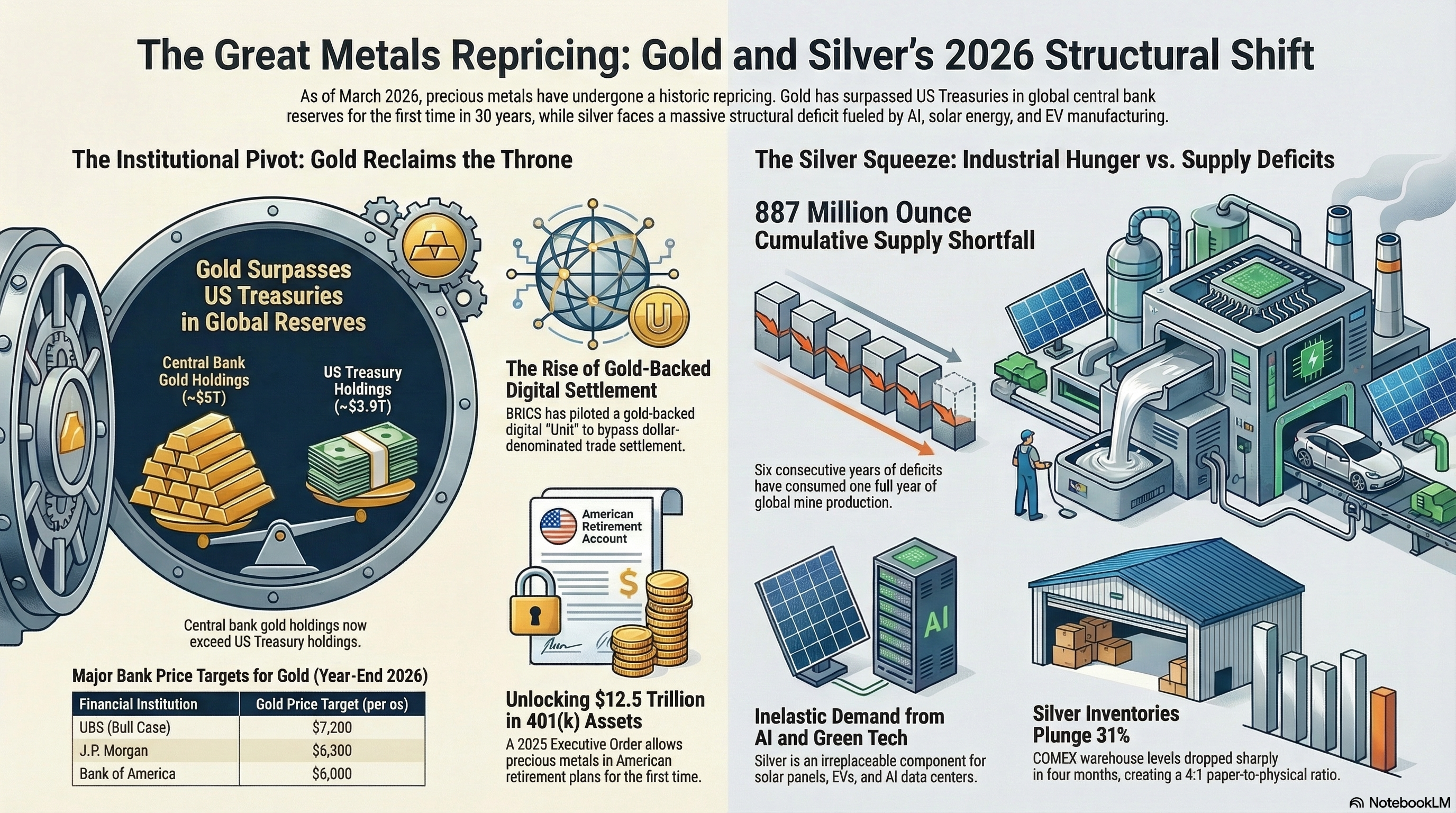
As of early 2026, the world's central banks hold roughly $5 trillion in gold versus $3.9 trillion in US Treasuries. That's the first time gold has overtaken American government debt in sovereign reserves since 1996 — before Google existed, before the euro launched, before most of today's workforce was old enough to vote.
The institutions that quite literally manage the world's money supply have collectively decided that a physical metal pulled from the ground is a more trustworthy store of value than the bonds issued by the world's largest economy. Gold sits near $4,906/oz as of March 18, up roughly 73% year-over-year. Silver trades around $77/oz, up 128% over the same period, and is running its sixth consecutive annual supply deficit.
We think this is the most important financial story of the decade. And almost nobody is talking about it.
How We Got Here
This didn't happen overnight. Central banks have been net gold buyers for 17 consecutive years, quietly accumulating while the financial media obsessed over crypto, meme stocks, and AI valuations. But the pace accelerated dramatically after 2022 — the year Western nations froze over $300 billion in Russian central bank reserves following the invasion of Ukraine.
That single act was a watershed. Every central banker on the planet — from Warsaw to Beijing to Brasília — registered the same lesson: dollar-denominated assets can be weaponized. Your reserves are safe — until they're not. As Robert Winmill noted in a CBS News analysis: "Dollar-denominated assets are seen as increasingly risky in view of US sanctions, denial of SWIFT privileges, asset seizures, military interventions and similar actions."
The response was immediate and structural. Central banks purchased 1,136 tonnes of gold in 2022 — the highest annual total on record. They followed with over 1,000 tonnes in both 2023 and 2024, and 863 tonnes in 2025. That's more than 4,000 tonnes absorbed by central banks in four years. Crucially, an estimated 57% of this buying was unreported, meaning the real totals are almost certainly higher.
In the World Gold Council's latest survey, 95% of central banks expect gold reserves to increase over the next year. Zero percent — literally none — expect a decline.
Why does this matter for everyday savers?
The forces driving sovereign institutions toward gold are the same forces eroding the purchasing power of savings accounts, 401(k)s, and paychecks:
The fiscal math is broken. US national debt: $38.5 trillion. Global sovereign debt: $340 trillion as of mid-2025. No political will from either party to address it. The likely path is managed currency debasement over time. Central banks understand this. That's why they're buying gold.
The Fed is stuck. The Federal Reserve held at 3.5–3.75% at its March 18–19 meeting, unable to cut rates (inflation is re-accelerating, with Core PPI at +0.8% month-over-month in January) or hike them (GDP growth has stalled near 1.4%). When the institution responsible for managing a currency's value has no good options, that currency's value faces risk. Gold doesn't need a central bank to decide what it's worth.
The world is de-dollarizing — slowly, but measurably. The BRICS bloc piloted a gold-backed settlement currency. India's central bank proposed linking BRICS digital currencies for cross-border settlement. China is courting foreign central banks to store gold in Shanghai. Germany's parliament debated bringing its gold home from the Fed. These are institutional decisions by sovereign nations, not fringe ideas. Foreign ownership of US Treasuries has fallen to ~30%, down from over 50% at the GFC peak.
The Silver Story
If gold is the headline, silver may end up being the bigger structural story. The data keeps getting more extreme.
Silver is now in its sixth consecutive annual supply deficit. The cumulative shortfall since 2021 is approximately 887 million ounces — nearly an entire year of global mine production consumed from above-ground stockpiles.
What's a supply deficit, and why does it matter?
A supply deficit means the world consumes more silver each year than mines produce and recyclers recover. The gap gets filled by drawing down existing inventories — vaults, warehouses, ETF holdings. When those run low, prices have to rise to balance the market. Silver has been in this deficit for six straight years, and the Silver Institute projects it will continue in 2026 with a forecast shortfall of 67 million ounces.
Why can't mines simply produce more? Because roughly 70% of silver is a byproduct of mining other metals — primarily copper, lead, and zinc. Silver mine output peaked in 2016 and hasn't recovered, because production decisions are driven by base metal economics, not the silver price.
Meanwhile, industrial demand is surging from multiple directions at once. Solar panels consumed approximately 197–232 million ounces of silver in 2024 alone. Electric vehicles use 25–50 grams of silver each — 67–79% more than gas cars. Nvidia's next-generation HVDC data centers will use significantly more silver per rack than current architectures. A peer-reviewed study projects that by 2030, global silver supply will meet only 62–70% of demand.
Gold is money. Silver is money and an industrial necessity. That dual identity makes silver's supply-demand imbalance structurally different from gold's — and potentially more consequential.
Under the Hood: The Technical View
This section is for readers who want the raw data, ratio analysis, and analyst targets. If you'd rather skip to the plain-English takeaway, jump to "What It Means" below.
Gold Price Trajectory
Gold opened 2025 at ~$2,624/oz and gained 64.6% for the year — its biggest annual gain since 1979 — before hitting an all-time high of $5,608/oz on January 28–29, 2026. A 22% correction to ~$4,400 followed in early February after the Warsh Fed chair nomination. Gold recovered to $4,906 as of March 18. Sources: CBS News, Trading Economics
Silver Price Trajectory
Silver surged ~147% in 2025 to an all-time high of $121.64/oz on January 29, 2026 — its first breach of $100. It has since corrected to $77–$80, still up 128% year-over-year versus gold's 73%.
Central Bank Buying: Country-by-Country (2025)
| Country | 2025 Purchases | Total Holdings | Gold as % of Reserves |
|---|---|---|---|
| Poland | 102 tonnes | 550 t | ~28% |
| Kazakhstan | 57 tonnes | ~182 t | ~20% |
| Brazil | 43 tonnes | 172 t | ~7% |
| Turkey | 27 tonnes | 644 t | — |
| China (PBOC) | 27 tonnes | 2,309 t | ~10% |
| Czech Republic | 20 tonnes | 72 t | — |
Poland is the world's largest buyer for the second straight year, targeting 700 tonnes for national security reasons. China's PBOC has bought gold for 16 consecutive months.
Silver Supply/Demand Balance (2021–2026)
| Year | Supply (Moz) | Demand (Moz) | Balance (Moz) |
|---|---|---|---|
| 2021 | 1,023 | 1,112 | -89 |
| 2022 | 1,034 | 1,306 | -272 (record) |
| 2023 | 998 | 1,208 | -210 |
| 2024 | 1,009 | 1,160 | -151 |
| 2025E | 1,022 | 1,117 | -95 |
| 2026F | ~1,050 | ~1,117 | -67 |
Source: Silver Institute / Metals Focus World Silver Survey 2025, Visual Capitalist
Cumulative deficit 2021–2026: approximately 887 million ounces. COMEX registered silver — the physical metal available for futures delivery — has plunged ~83% since 2021 to roughly 25–35 million ounces. Total COMEX inventory fell to ~366 million ounces by late February, down 31% in four months.
The Gold-to-Silver Ratio (GSR)
The gold-to-silver ratio — how many silver ounces it takes to buy one ounce of gold — sits near 63:1, down from approximately 100:1 a year ago. In prior bull markets, this ratio compressed to 30–40:1. If gold reaches the consensus $5,400–$6,000 range and the ratio hits 40:1, that implies silver near $135–$150.
The counterpoint, from J.P. Morgan's Greg Shearer: "without central banks as structural dip buyers as in gold, there remains the risk for a further move back higher in the gold-to-silver ratio." Silver lacks the official-sector demand floor that gold enjoys — making it more volatile and more dependent on industrial fundamentals.
Wall Street Gold Price Targets (2026)
| Institution | Year-End 2026 Target | Notes |
|---|---|---|
| J.P. Morgan | $6,300/oz | Raised Feb. 25; structural floor $4,500 |
| Goldman Sachs | $5,400/oz | "Conviction buy" |
| Deutsche Bank | $6,000/oz | Reiterated Feb. 2026 |
| UBS | $6,000–$7,200/oz | $7,200 bull case |
| Bank of America | $6,000/oz | Within 12 months |
| BNP Paribas | >$6,250 peak | Average forecast raised 27% |
| Reuters Survey (30 analysts) | $4,747 median | Full-year average |
Every major bank targets above the current spot price. J.P. Morgan's Natasha Kaneva: "the long-term trend of official reserve and investor diversification into gold has further to run." The bear case, per the World Gold Council: if growth picks up and the Fed hikes, gold could fall 5–20%. A ceasefire in the Iran conflict would also remove a meaningful risk premium.
Key Risks We're Monitoring
- Dollar strength from oil-driven inflation. With Brent crude above $108/barrel following the Strait of Hormuz disruptions, inflation expectations are pushing the Fed toward "higher for longer." A stronger dollar creates a headwind for gold, which is priced in dollars.
- Technical consolidation. Gold is down ~12.5% from its January ATH; silver is down ~36%. Both face normal consolidation pressure after parabolic moves. For those dollar cost averaging, pullbacks like these mean each monthly purchase acquires more ounces — that's the mechanism working as designed.
- Solar silver thrifting. The solar industry is accelerating copper substitution — LONGi announced copper back-contact cells for mass production in Q2 2026. This is a legitimate headwind for silver industrial demand, though the Silver Institute still forecasts a 67 Moz deficit even with thrifting factored in.
What It Means
Here's the plain-English version of everything above.
The gold story is structural, not speculative. Central banks have been buying for 17 straight years and now hold more gold than US Treasuries. The World Gold Council's 2025 survey is unambiguous: 95% expect to keep buying. None expect to sell. When the institutions that print the money prefer gold over their own bonds, it signals something about what they think is coming.
Silver's deficit is real and getting harder to fix. Six consecutive years of consuming more than the world produces. Nearly 900 million ounces drawn from stockpiles. Mine production peaked a decade ago and won't recover because most silver is a byproduct of other mining. The demand drivers — solar, EVs, AI — are in their early innings, not their twilight. Even with substitution efforts, the Silver Institute projects another deficit in 2026.
The policy backdrop favors hard assets. The Fed is frozen. The US government has no fiscal discipline path. The 401(k) executive order puts $12.5 trillion in retirement savings in play for precious metals. BlackRock is launching a target-date fund with gold exposure in H1 2026. When the world's largest asset manager builds gold into default retirement products, that's a signal worth attention.
This is not a recommendation. We don't know where prices go next week. We do know the structural forces — sovereign debt expansion, central bank accumulation, silver deficits, de-dollarization — are not resolving. They're intensifying. The historical case for consistent accumulation over time remains as strong as ever — gold has delivered a 10.9% annualized return since 2000, and has never produced a negative return over any rolling 20-year period since 1971. Our job is to lay out the data so you can draw your own conclusions.
What We're Watching This Week
The FOMC aftermath. The Fed held at 3.5–3.75% as expected. Markets price a 92% probability of a June cut. If that expectation shifts, gold reprices fast.
Iran and oil. Brent above $100 since March 13. De-escalation removes the geopolitical premium. Escalation pushes oil higher, strengthens the dollar, and paradoxically creates near-term headwinds even as it strengthens the long-term bull case.
Central bank data. J.P. Morgan projects ~755 tonnes of purchases in 2026. Poland's pace toward 700 tonnes and China's PBOC monthly reports are the numbers to watch.
The gold-to-silver ratio. At 63:1, normalized from 100:1 a year ago. Whether it compresses toward 40:1 or rebounds will shape silver's relative performance through year-end.
The repatriation movement. India moved 274 tonnes home. Germany's Bundestag debated doing the same. Italy's parliament declared the central bank's gold "belongs to the people." Each headline reinforces gold's relevance.
Until Next Week
The gold-versus-Treasuries crossover isn't a headline — it's a signal. And signals like this tend to play out over years, not days. We'll keep tracking the data, challenging the narratives on both sides, and telling you what we actually think.
Next week on Sound Money Weekly, we're digging into the silver supply chain — where the metal actually comes from, why new mines take 10–15 years to build, and what the 2030 demand projections mean for this market. See you then.
Sound Money offers fractional gold and silver ownership. Learn more at sound.money.
Disclaimer: This content is provided by Sound Money for educational and informational purposes only. Nothing published here constitutes investment advice, financial advice, trading advice, or any other form of professional advice. Sound Money is not a registered investment advisor, broker-dealer, or financial planner. The information presented reflects our analysis of publicly available data and should not be relied upon as a basis for investment decisions. Precious metals investments carry risk, including the potential loss of principal. Past performance does not guarantee future results. Always consult a qualified financial advisor before making investment decisions. For more information about Sound Money's products and services, visit sound.money.
- gold
- silver
- investing
- central-banks
- global-economy
- inflation