Gold Now Outranks U.S. Treasuries in Global Reserves. Hot CPI Just Made It Cheaper.
Gold hit 27% of global CB reserves, overtaking Treasuries. Then May CPI printed 4.2%, gold fell to $4,172 — and bounced back to $4,343.
There are weeks in markets that contain one major story. Last week had three — and they all pointed at the same thing.
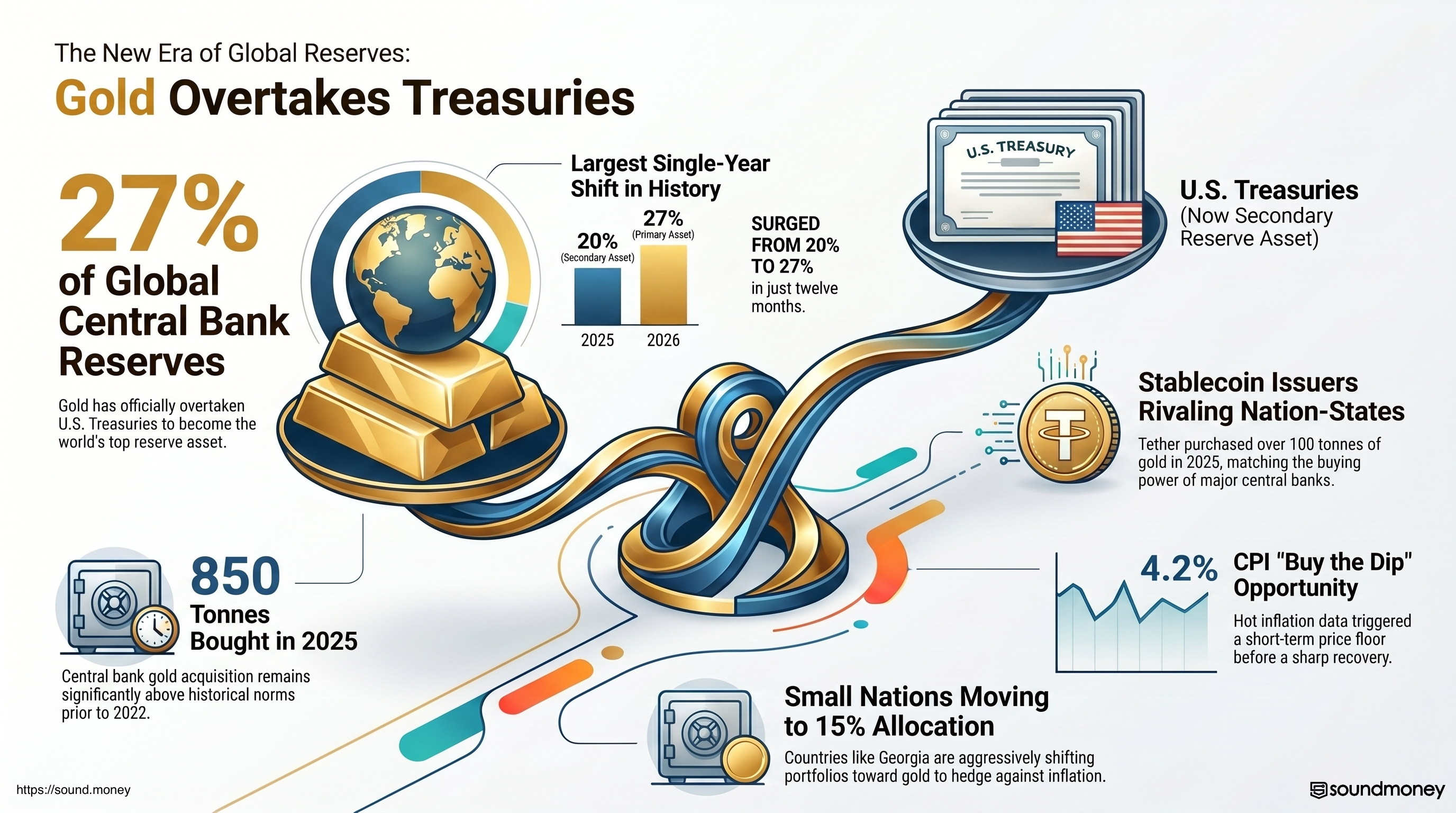
The European Central Bank published a landmark report confirming that gold now accounts for 27% of global central bank reserves, up from 20% a year earlier — officially overtaking US Treasuries as the world's top reserve asset. That same week, May CPI printed at 4.2% year-over-year, above the 4.0% consensus and accelerating from April's 3.8%. Gold fell to $4,172 before recovering to $4,343 today. And Kevin Warsh's first FOMC meeting is scheduled for Tuesday and Wednesday this week.
If you're a DCA investor, here is the complete read on what just happened and what it means for your position.
What Happened Last Week
Tuesday, June 10 — The CPI Hit
May's Consumer Price Index came in at 4.2% year-over-year — the third consecutive month of acceleration and the hottest reading since 2023. The consensus had been 4.0%. The reaction was immediate: the dollar surged, Treasury yields moved higher, and gold fell 2.1% to $4,172.44, its lowest level since late March.
The same day, renewed hostilities in the Iran-Israel conflict removed some of the ceasefire optimism that had underpinned gold in the prior weeks.
Thursday, June 11 — The ECB Rate Hike
The European Central Bank raised interest rates for the first time since 2023, citing persistent inflation across the eurozone. This added another layer of "higher-for-longer" pressure globally. When two of the world's largest central banks are moving hawkishly at the same time, risk assets — including gold, in the short term — feel it.
Friday, June 12 — The Reversal
President Trump publicly claimed the Iran-Israel conflict had ended, sending gold futures sharply higher to open at $4,234 — a 3.4% intraday gain. The geopolitical fear premium has been volatile, but the pattern is clear: every time Iran-related tension eases, it removes a layer of support; every time it escalates, that support snaps back.
Today, June 15 — $4,343
Gold is trading at $4,343, up $148 from its June 12 open, as markets digest the ceasefire signal and position ahead of Warsh's first FOMC meeting.
The ECB Report: A Structural Shift in Plain Numbers
While the macro noise dominated the headlines, the real story of the week was published two weeks ago and still hasn't fully landed in mainstream financial media.
On June 2, the European Central Bank released its International Reserves and Foreign Currency Liquidity report, and the headline figure deserves to be read slowly: gold now represents 27% of global central bank reserve assets — up from 20% a year earlier. That seven-percentage-point increase in a single year is not a rounding error. It is the largest single-year shift in the composition of global reserves in modern history.
For context: US Treasuries have historically been the world's dominant reserve asset — the thing every central bank holds because the dollar is the world's reserve currency. That relationship is now structurally changed. More official gold is held globally than US Treasuries. This is not a prediction or a forecast. It is the present tense.
Central banks bought approximately 850 tonnes of gold in 2025, down from the 1,000+ tonne pace of 2022-2024, but still well above any historical norm prior to 2022. The ECB describes this as a permanent structural change — not a cycle.
Under the Hood: The Buyer Nobody Saw Coming
Here is something almost no mainstream outlet is connecting: the largest single buyer of gold in 2025 was not a central bank.
The ECB's report flagged that Tether — the issuer of the world's largest stablecoin — purchased more than 100 tonnes of gold in 2025. For comparison, Poland, which led all central banks in 2025, also bought approximately 100 tonnes. Tether's purchases were larger still.
What does it mean when a crypto company is buying gold at nation-state scale? The ECB's interpretation is pointed: stablecoin issuers are reaching for physical metal as a reserve backing for their digital dollar instruments. The largest stablecoin in the world — a digital instrument that holds $100+ billion in "reserve assets" — is choosing gold alongside T-bills. The ECB notes this carries potential macroeconomic significance if stablecoin growth continues.
This is demand that did not exist five years ago. It is not cyclical. It will not disappear when the next jobs report prints strong. Tether needs gold to back its stablecoin regardless of what the Fed does on Wednesday.
Smaller Buyers, Same Signal
One more data point worth noting: last week's coverage mentioned Georgia's central bank adding $100 million in LBMA-standard gold bars, pushing its total reserves to a record $7 billion with gold now at 15.5% of its portfolio. Georgia is not a major player in the gold market. But the fact that a small Eastern European economy is deliberately moving its reserves toward 15% gold — in the same year the ECB confirms gold has overtaken Treasuries globally — is the pattern expressing itself at every level of scale.
What the CPI Print Actually Means for Gold
This is where the counterintuitive part of the analysis matters.
The conventional reaction to hot inflation is: higher rates → stronger dollar → lower gold. That is exactly what happened on June 10. But zoom out six months and the relationship inverts. Gold's historic all-time highs at $5,608 in January were set precisely because inflation at 3.8% was driving institutional hedging demand. The argument that gold thrives in an inflationary environment is not contradicted by a short-term rate-mechanism reaction — it is supported by the structural demand data we just reviewed.
The short-term pain is real. The May CPI at 4.2% makes a June rate cut essentially impossible and raises the probability of a hike later this year (markets are pricing roughly 20 basis points of tightening by December). That is a headwind for gold's spot price.
But it is also the reason the central banks, Tether, and the DCA investors who bought March's lows are holding and adding. Inflation at 4.2% is precisely the scenario that those 27% of reserves are hedging.
The Math at $4,343
You are buying gold today at $4,343 — $1,265 below January's all-time high of $5,608. Every dollar you commit this month is buying 22.5% more metal than it would have six months ago.
At $200/month:
- June purchase: 0.04605 oz at $4,343
- Annual accumulation at this price: 0.5527 oz over 12 months
- Total invested: $2,400
- At Goldman's year-end target of $4,900: position worth $2,708 — a +12.8% return on your contributions
That math does not require gold to make a new all-time high. It requires only that Goldman's thesis — sticky central bank demand, accelerating ETF inflows, structural reserve shifts — continues to play out at the pace the ECB just confirmed.
Fractional ownership at whole-ounce pricing means every dollar of your monthly contribution is working at spot, not paying a 20-30% fractional premium. The Sound Money structure was built for exactly this kind of DCA math.
What We're Watching
June 16–17 — Warsh's First FOMC
This is the most closely watched event of the week. No one expects a rate cut. The question is tone. With CPI at 4.2% and accelerating, Warsh faces his first real communications test: does the new chair signal that the bar for hikes has lowered? Any language removing the easing bias — or explicitly acknowledging the possibility of a hike — would add pressure to gold in the near term. Conversely, if Warsh maintains a "wait and see" posture, the relief rally in gold could extend.
Watch the post-meeting statement language, not the decision itself. The decision is baked in.
Iran-Israel Ceasefire
Trump's claim that the war has ended is not a binding ceasefire agreement. Watch for follow-through from Tehran in the next 48-72 hours. If the claim doesn't hold, gold's geopolitical floor reasserts itself quickly.
India Import Demand Post-15% Duty
India raised its effective gold import duty to approximately 15% in May. The immediate effect is predictable: official imports slow, smuggling increases (dealers estimate over 100 tonnes in 2026 through informal channels), and the price wedge between official and grey-market gold widens. The real story isn't the tax — it's what it tells you about demand. When a country imposes a 15% toll on gold and people pay it anyway (or route around it), that is an expression of demand that doesn't show up in official trade data. It shows up in the gold price.
The Bottom Line
A landmark ECB report, a hot CPI print, an ECB rate hike, and a ceasefire claim — all in five trading days. The short-term effect on gold was a selloff to $4,172 followed by a bounce to $4,343. The structural effect is that gold now officially outranks US Treasuries as a global reserve asset, and the buyer base has quietly expanded to include one of the world's largest stablecoin issuers operating at the tonnage scale of a sovereign.
The week gave DCA investors a $4,172 floor. Gold is at $4,343 today. Warsh speaks Wednesday.
This article is for informational purposes only and does not constitute investment advice. Past performance of gold and silver prices is not indicative of future results. Always conduct your own research and consult a qualified financial advisor before making investment decisions. Sound Money provides fractional precious metals ownership services — see sound.money for full terms and conditions.
- gold
- silver
- precious-metals
- central-banks
- federal-reserve
- inflation
- ecb
- tether
- dollar-cost-averaging