Close Your Position or Take the Metal: What China Just Did to Its Paper Gold Market
China's biggest banks closed retail paper gold July 24. Millions had to choose: cash or physical metal. Then China expanded Hong Kong vaults to 64 million oz.
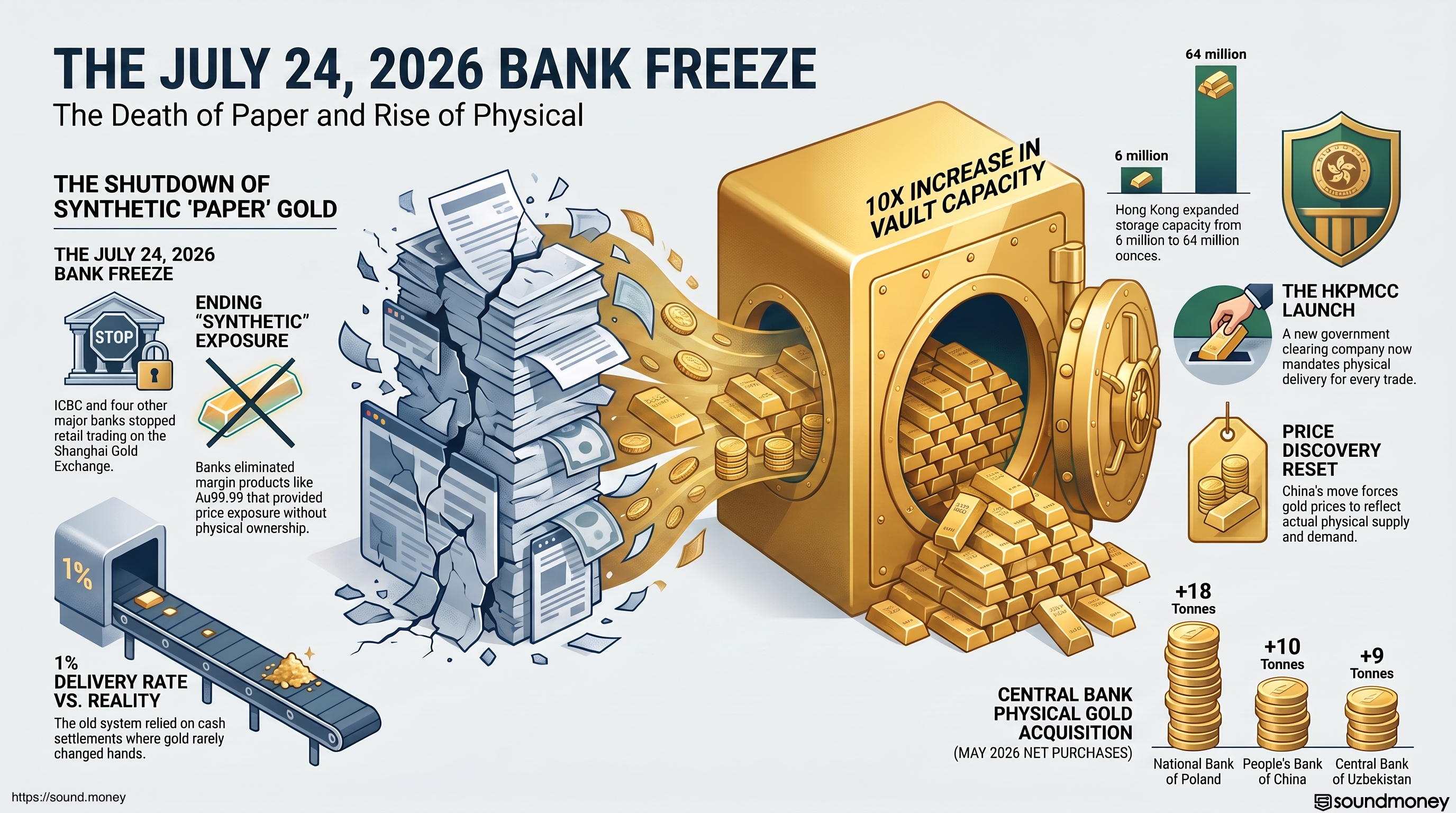
On July 24, 2026, ICBC — the world's largest bank by total assets — flipped a switch.
All retail precious metals trading on the Shanghai Gold Exchange stopped. The product menu disappeared from mobile banking, online banking, and branch counters. Customers who had held positions — some for years — received a single-line notice: close your position, liquidate your holdings, or take physical delivery.
ICBC was not alone. Postal Savings Bank of China, Ping An Bank, China Guangfa Bank, China Construction Bank, and Bank of China each made the same announcement in the same narrow window of time. Five of the world's largest financial institutions — collectively holding trillions in assets — shut off the same product on the same day.
The official explanation: investor protection. Gold's 30% drawdown from January's all-time high created severe losses for leveraged retail accounts. Shutting down the margin products protects ordinary customers from extreme price swings.
That explanation is true. It's also incomplete.
What Paper Gold Is — and Why It Matters
Most people who have held a "gold account" at a Chinese bank have never touched an ounce of gold. The products being shut down were synthetic: spot margin contracts (Au99.99, Au100g) and deferred delivery contracts (Au T+D) that gave retail investors price exposure to gold without ever transferring ownership of a specific bar.
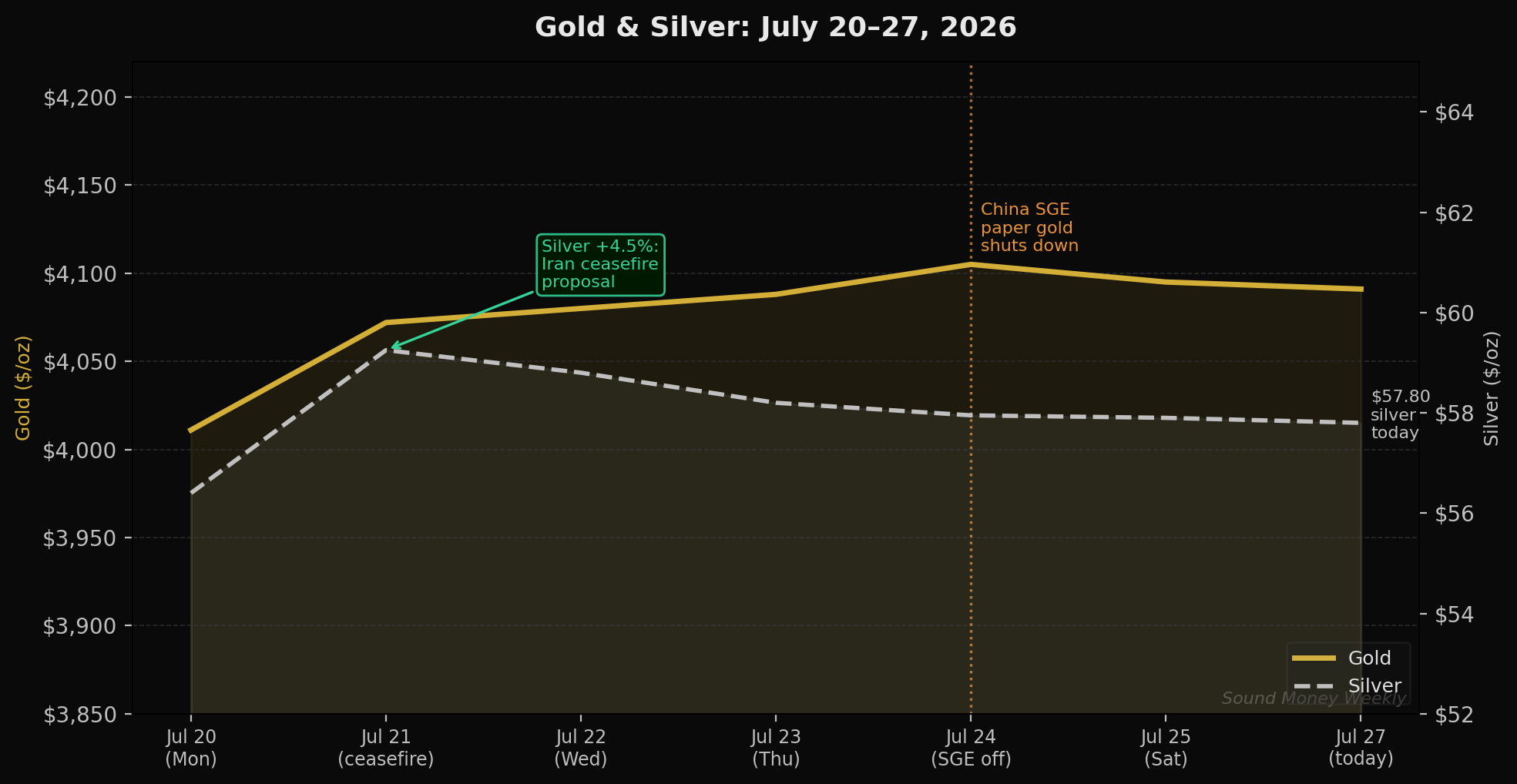
The product worked like this: you deposited cash. The bank intermediated your position on the Shanghai Gold Exchange. You could buy, sell, and hold as though you owned gold. But fewer than 1% of these contracts globally ever end with physical metal changing hands. The rest settle financially — dollars in, dollars out, gold never touched.
On the COMEX in New York, the dominant global gold futures exchange, the physical delivery rate is below 1%. On the LBMA in London, unallocated gold accounts — where your metal isn't assigned to specific numbered bars — represent the vast majority of holdings. This system works because the overwhelming majority of participants never actually want the gold. They want exposure to its price.
When that assumption breaks — when more people want the physical metal than the system has — prices in the paper market and the physical market can diverge.
What China Built While Closing the Paper Window
Here is the part that didn't make most headlines.
The same month that ICBC closed its retail paper gold window, the Hong Kong government launched the Hong Kong Precious Metal Central Clearing Company (HKPMCC) — a new government-owned physical gold settlement hub anchored in Hong Kong and linked to the Shanghai Gold Exchange. Its mandate: physical delivery on every trade. No unallocated positions. Every transaction requires actual metal to move between vaults.
To support this infrastructure, Hong Kong's gold vault capacity expanded from approximately 6 million ounces to 64 million ounces — a tenfold increase, announced alongside the HKPMCC launch. The storage is purpose-built for high-throughput physical settlement, not long-term reserve storage.
China isn't shutting down its gold market. It's replacing the paper layer — the margin products, the leveraged retail access, the cash-settled contracts — with a physical settlement infrastructure that requires real metal to change hands on every trade.
The Canadian Mining Report noted the parallel to the 1968 collapse of the London Gold Pool — a moment when the gap between paper claims on gold and actual physical gold supply became unsustainable, forcing a reset in how gold was priced. China's July 24 action moves its domestic market toward a system where the gold price reflects actual physical supply and demand, not the balance of leveraged paper positions.
What physical gold is worth when the measurement requires actual delivery is, structurally, a different number than what it's worth when 99% of contracts cash-settle.
What Central Banks Did in May: +41 Tonnes
While markets were focused on macro headwinds, the World Gold Council released its May 2026 central bank data on July 2 — and it showed the strongest monthly buying pace of the year.
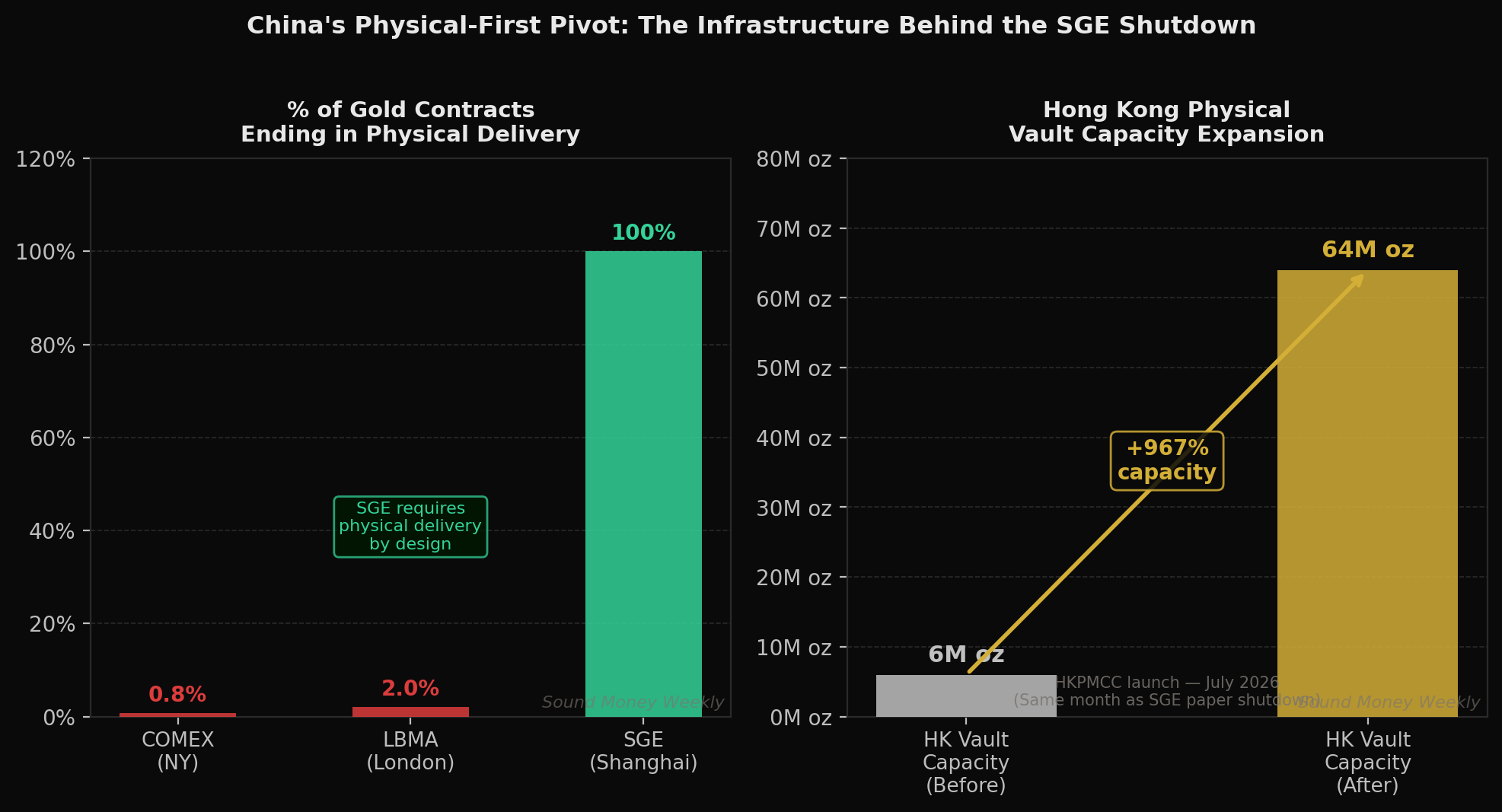
Net +41 tonnes in May — more than double April's 19 tonnes.
Poland led with 18 tonnes, its fourth consecutive month of double-digit purchases, bringing its reserves to 614 tonnes as it pursues a declared 700-tonne target. China added 10 tonnes — its largest monthly addition since December 2024, marking the 20th consecutive month of buying. Uzbekistan added 9 tonnes, Kazakhstan 7 tonnes, and Singapore returned to buying after a several-month absence, adding 4 tonnes.
Russia sold 6 tonnes and Turkey reduced by 3 tonnes — but the net buying margin is overwhelming. The Czech National Bank has now purchased gold for 39 consecutive months.
This data covers May — the month gold fell 1.8%. The data covering June — when gold fell 11.65% — will arrive in early August. Based on the PBOC's reported 15-tonne June purchase and the buying-into-weakness pattern now established across multiple central banks, the June figures are likely to maintain or accelerate the trend.
Silver's Ceasefire Bounce
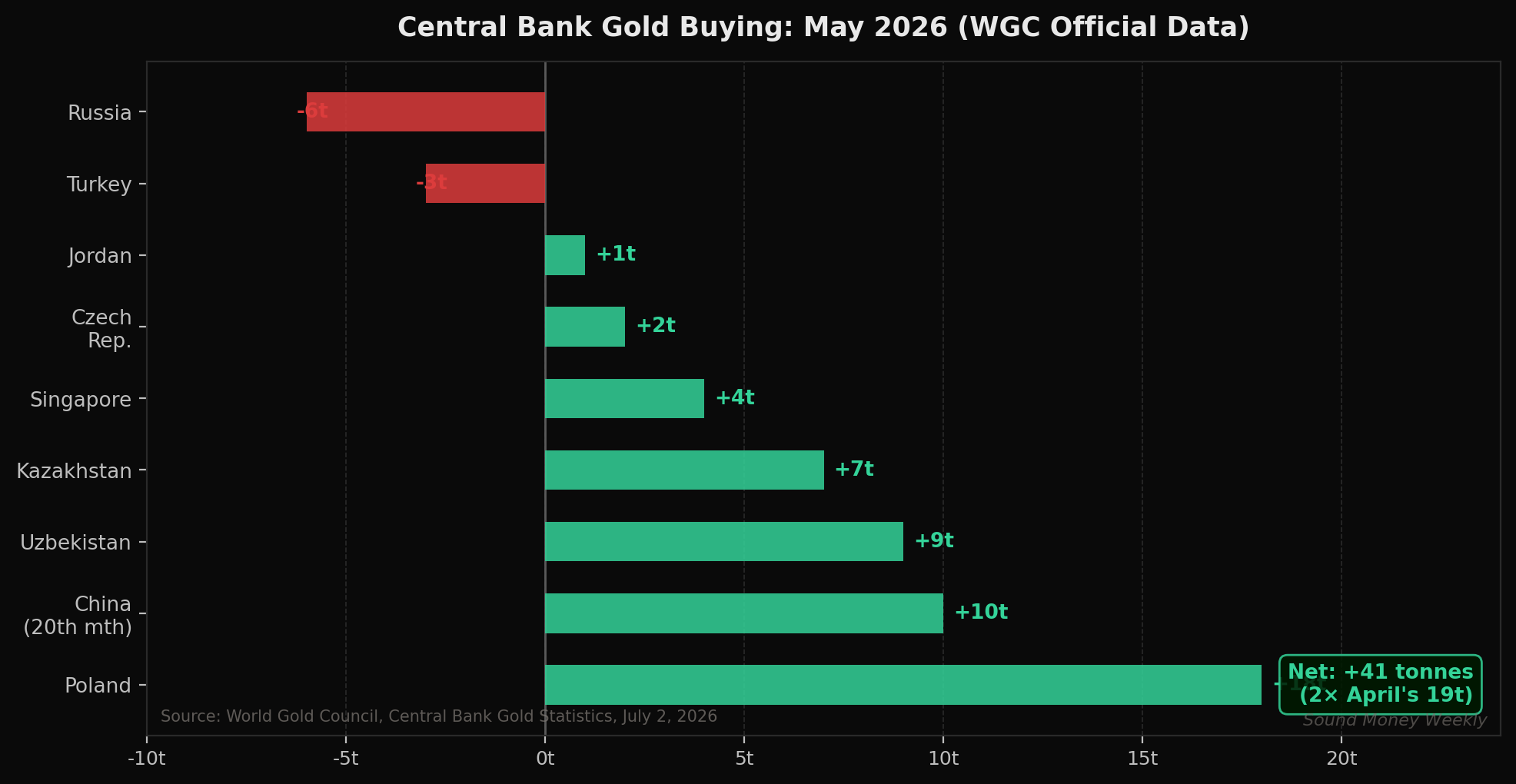
Tuesday, July 21, silver jumped 4.5-5% in a single session to $58.96. Gold gained 1.6%. Silver outperformed gold by more than 3:1 on the session.
The catalyst: Iranian officials confirmed to Reuters that Tehran had received a 10-day ceasefire proposal from mediators. The news immediately unwound the oil-spike inflation premium that had been keeping metals under pressure. Brent crude pulled back, inflation expectations eased, September rate-hike probability dropped from approximately 64% toward 55%, real yields softened, and silver — which runs on both monetary safe-haven demand and industrial demand — captured more upside than gold on the same news.
As of today, silver is at $57.80 — slightly off its July 21 peak but still holding most of the week's gains. The gold-silver ratio has compressed modestly from last week's 70.8:1 and remains elevated historically.
The geopolitical situation remains live. A Houthi naval blockade of Saudi Arabia sits outside the ceasefire framework. The Iran-US core demands haven't been resolved. Every oil price move in the next 30 days will echo through the inflation-rates-gold chain in either direction.
What This Means for DCA Investors
The China SGE shutdown is not directly about Sound Money, American investors, or fractional ownership. But it reinforces one of the core premises underlying Sound Money's model: the structure of how you own gold matters.
Paper gold — leveraged contracts, synthetic exposure, cash-settled positions — performs well as a speculative vehicle in trending markets. When things break down, when liquidity is questioned, when central banks are repatriating gold, when China is forcing its retail market toward physical settlement, paper's limitations show. Millions of Chinese investors discovered last week that their "gold" was a cash-settled position in a product their bank no longer wanted to offer.
Physical gold, owned as allocated bars through a custodian that holds the actual metal on your behalf, doesn't carry that risk. The metal exists. It's in a vault. It's yours.
At $4,091 today:
- $200/month buys 0.04889 oz — still 37.1% more metal per dollar than January's $5,608 all-time high
- 12 months of $200 contributions: 0.5867 oz on $2,400 invested
- At Goldman's $4,900 target: $2,875 — a +19.8% return on monthly contributions
What We're Watching
FOMC July 28–29 — Warsh Speaks Tomorrow
This is a non-projection meeting — no dot plot, no updated economic forecasts. The entire signal is in the statement language and Warsh's press conference tone. After June's 3.5% CPI, the key question is whether Warsh acknowledges the disinflationary data while maintaining his hawkish posture. Watch specifically for whether the policy-bias sentence changes — "further firming may be appropriate" versus a softer framing.
June CB Buying Data (WGC release ~August 6)
The PBOC's 15-tonne June purchase is confirmed. Whether other central banks also accelerated their buying during June's 11.65% gold decline will determine whether the May data's +41 tonnes was an outlier or part of an accelerating structural trend. If the June WGC print is 40+ tonnes, the "central banks buy the dip" narrative becomes impossible to ignore.
Hong Kong Physical Hub Development
HKPMCC is now operational. Watch for announcements on member institutions, vault occupancy, and whether physical delivery volumes through Hong Kong begin to register in monthly data. If China's domestic gold price (SGE benchmark) begins consistently diverging from the London/COMEX paper price, it will be a direct expression of physical price discovery beginning to assert itself.
July CPI — August 12
After June's 3.5% disinflationary print, July CPI is the next major read on whether May's 4.2% was a peak or an interruption. Oil's re-spike on Hormuz tensions may reverse some of June's energy decline, pushing July's headline CPI back up. Core CPI — flat in June — is the cleaner signal.
The Bottom Line
On July 24, the world's largest bank told millions of retail investors they could no longer hold leveraged exposure to gold through a bank app. They could cash out, or they could get the gold.
Simultaneously, China expanded its physical gold vaulting capacity tenfold and launched a physical settlement hub that requires actual metal to change hands on every trade.
Central banks bought 41 tonnes of gold in May — double the previous month, buying into a declining price environment. Silver jumped 5% on ceasefire news and is holding. Warsh speaks tomorrow.
The direction of travel for gold is not ambiguous. The path there is.
This article is for informational purposes only and does not constitute investment advice. Past performance of gold and silver prices is not indicative of future results. Always conduct your own research and consult a qualified financial advisor before making investment decisions. Sound Money provides fractional precious metals ownership services — see sound.money for full terms and conditions.
- gold
- silver
- precious-metals
- china
- sge
- paper-gold
- physical-gold
- central-banks
- hong-kong