The Ceasefire Bounce: Gold Hits $4,808 as Iran Stands Down
The US-Iran two-week ceasefire sent gold to a three-week high, silver surged 4.7% in a single session, and Poland quietly bought 20 tonnes. Here is what this week means for precious metals and the people stacking them.
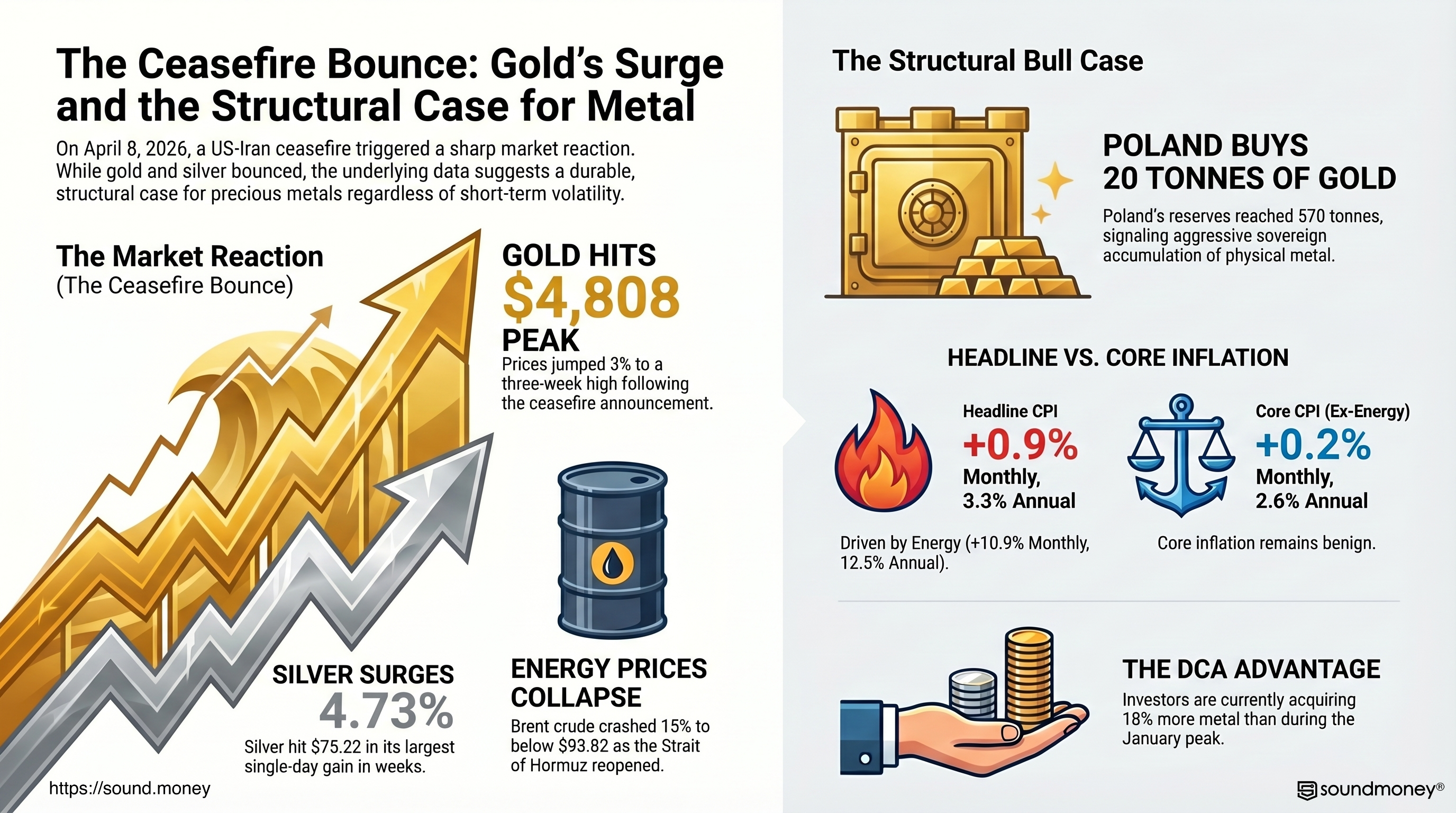
Iran stood down. Oil crashed. Gold hit a three-week high. Silver jumped nearly 5% in a day. And while the headlines chased the diplomacy, Poland quietly loaded up 20 tonnes. This week had everything.
The Ceasefire Bounce: Gold Hits $4,808 as Iran Stands Down
Sound Money Weekly | April 13, 2026
The Hook
For six weeks, one variable held gold hostage: the Iran conflict and the oil shock it produced. That variable changed on Tuesday, April 8, when the United States and Iran agreed to a two-week ceasefire brokered by Pakistan, just minutes before Trump's deadline to destroy Iranian civilian infrastructure would have triggered.
The market's response was swift and unambiguous. Gold jumped 3% to a three-week high. Silver surged 4.73% to $75.22 in a single COMEX session -- its largest single-day move in weeks. Brent crude crashed 15% to below $93.82 within hours of the announcement.
Then came the complications. Friday's March CPI came in at 3.3% -- the hottest print in nearly two years -- which spooked markets even though the data was almost entirely energy-driven with benign core inflation. And this morning gold futures opened down 3.2% to $4,633 on reports of fresh Hormuz tensions over the weekend, a reminder that a two-week ceasefire is exactly that -- two weeks.
Meanwhile, the World Gold Council's February data quietly told a more durable story: Poland bought 20 tonnes in a single month, bringing its reserves to 570 tonnes and targeting 700. Central banks are not sitting on the sidelines waiting for clarity. They are loading up.
For consistent stackers, this week offered something important: a glimpse of what gold looks like when the headwinds ease. The ceasefire catalyst sent prices to $4,808 in a single session. When the Islamabad talks produce a lasting deal -- not if -- the move could be multiples of that.
The Week in Full
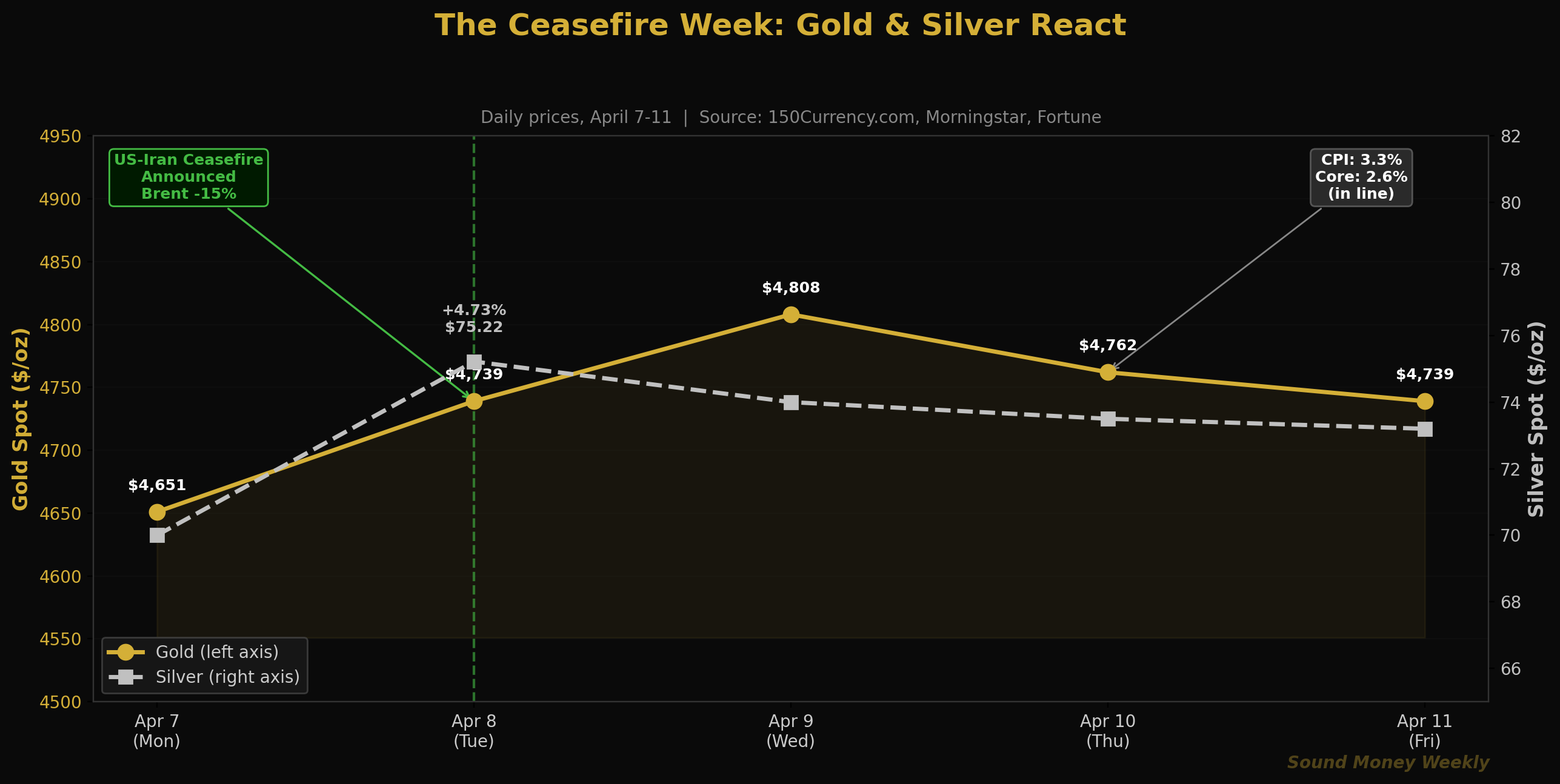
Monday, April 7: Gold opened the week at $4,651 as Trump extended his strike pause and markets waited for clarity. Silver slipped to $70 on residual Hormuz uncertainty. Relatively quiet.
Tuesday, April 8: The defining session of the week. Shortly before Trump's deadline, Iran and the US agreed to a two-week ceasefire mediated by Pakistan's Prime Minister Sharif and Army Chief Munir. The Strait of Hormuz would reopen immediately. Gold jumped intraday to $4,802. COMEX silver settled +4.73% at $75.224 -- its largest single-day gain since early March. Brent crude plunged 15% to $93.82.
Wednesday, April 9: Gold extended gains to $4,808 -- its highest close since March 19, the first day of the historic selloff. As of 9 AM ET, prices had already moderated to $4,743 as markets processed the fragility of the deal. VP Vance, envoy Witkoff, and Jared Kushner arrived in Islamabad for face-to-face negotiations with Iran's foreign minister and parliament speaker.
Thursday, April 10: March CPI dropped at 8:30 AM. The headline print of 3.3% -- up from 2.4% in February -- was the hottest in nearly two years and created initial anxiety. But gold held at $4,762, barely dipping. The market read the data correctly: all energy, no structural inflation threat (details below).
Friday, April 11: Gold closed the week at $4,739. Silver at $73.20. Gold gained approximately 1.9% for the week from Monday's $4,651 open -- modest but meaningful after seven consecutive days of losses in the prior two weeks.
Weekend / Monday morning: Hormuz tensions flared briefly over the weekend, sending gold futures down 3.2% to open at $4,633 this morning before recovering intraday to approximately $4,739. The Yahoo Finance daily price note confirms this gap-then-recovery pattern -- consistent with the ceasefire/Hormuz news cycle that has dominated price action for six weeks.
Three Stories Worth Understanding
1. The Ceasefire: What It Is and What It Isn't
The two-week ceasefire is a framework, not a resolution. Here's what Wikipedia's conflict timeline and the Carnegie Endowment analysis confirm:
- What's agreed: Immediate ceasefire, Hormuz reopening "via coordination with Iran's Armed Forces," delegations meeting in Islamabad starting April 10.
- What's still on the table: Iran's nuclear program, missile limits, proxy force restrictions, Israeli recognition, sanctions relief, asset unfreezing, a UN resolution framework.
- Iran's position: Presented its own 10-point proposal rather than accepting the US 15-point draft. The US calls it a "workable basis."
- The timeline: Two weeks to negotiate a comprehensive deal. The clock started April 8. That means approximately April 22 is the next inflection point.
The Islamabad talks represent the most substantive diplomatic engagement since the conflict began February 28. The presence of Vance, Witkoff, and Kushner signals the US is serious. Iran's willingness to reopen Hormuz -- even conditionally -- removes the single largest structural headwind for gold's rate-cut thesis.
If a permanent deal emerges: oil falls toward $80, inflation eases, the Fed reopens the door to cuts, and gold has a clear path back to and through $5,000. If talks collapse: Hormuz closes again, oil spikes, and the March pattern repeats. The two-week window is the most important variable in precious metals markets right now.
2. The CPI Report: Don't Be Fooled by the Headline
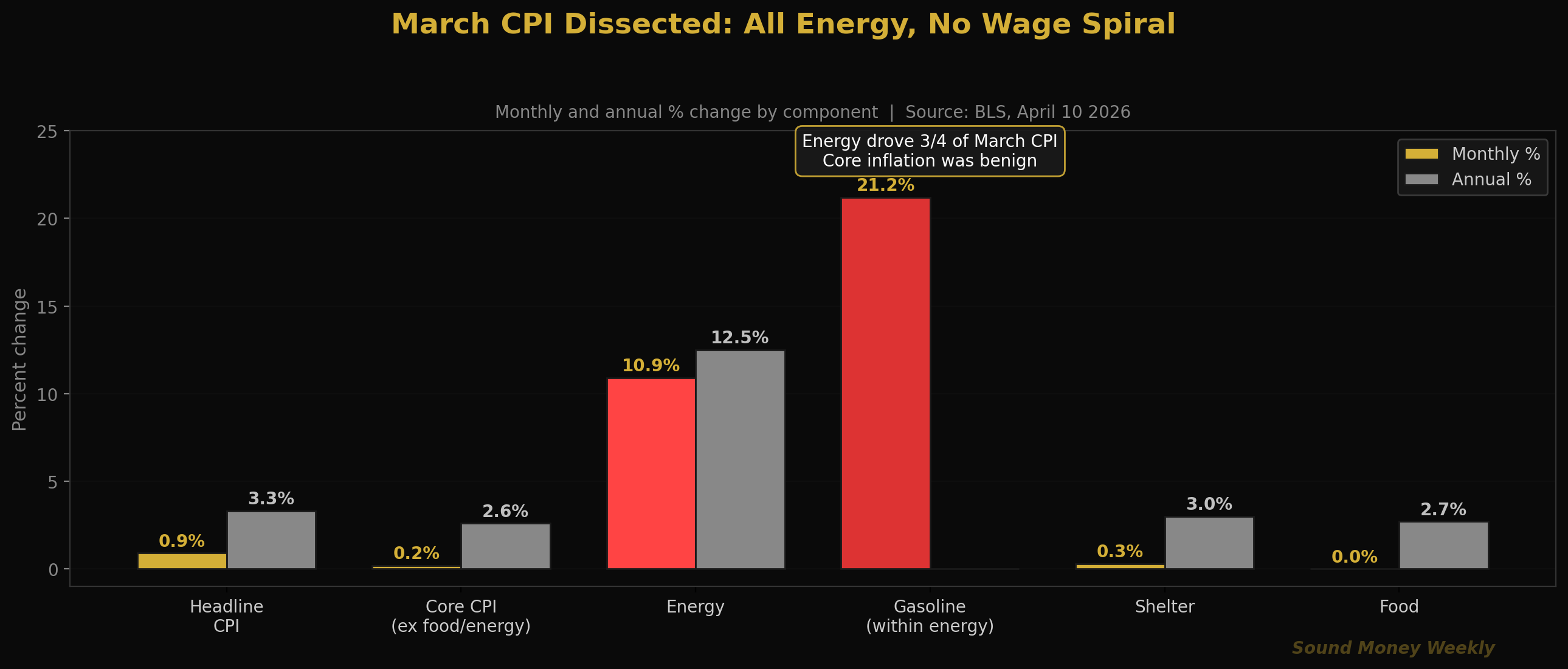
March CPI at 3.3% looks alarming until you look inside the number. The BLS data and PNC Economics' April 10 analysis tell a very different story:
| Component | Monthly Change | Annual Change |
|---|---|---|
| Headline CPI | +0.9% | 3.3% |
| Core CPI (ex food/energy) | +0.2% | 2.6% |
| Energy | +10.9% | 12.5% |
| Gasoline (within energy) | +21.2% | -- |
| Shelter | +0.3% | 3.0% |
| Food | 0.0% | 2.7% |
The headline number is almost entirely one thing: gasoline. Energy CPI spiked 10.9% in March alone, and gasoline alone accounted for nearly three-quarters of the entire monthly CPI increase. Core inflation -- which strips out food and energy -- came in at just 0.2% for the month and 2.6% annually. Shelter hit its lowest annual rate since August 2021.
This is an oil-price event masquerading as a broad inflation problem. The key implication: if Hormuz stays open and Brent crude continues its post-ceasefire retreat from $112 toward $85-90, the May CPI print could drop sharply. PNC's analysis explicitly states that "oil prices have fallen in the past week as the conflict has de-escalated," and that the energy spike is "on deck to reverse" in coming months.
Gold read this correctly. Despite the scary headline, gold held above $4,750 on CPI day and did not give back the ceasefire gains. The bond market told the same story: 10-year yields were largely unchanged after the data.
3. Poland Bought 20 Tonnes. Pay Attention.

While oil traders and macro desks fixated on ceasefire headlines, the World Gold Council quietly published February central bank data that contains one of the most important data points of the quarter: Poland bought 20 tonnes in a single month.
That's not a rounding error. Poland now holds 570 tonnes -- 31% of its total foreign exchange reserves -- and has explicitly targeted 700 tonnes. At its current buying pace, it will get there by end-2026. For context, Poland's 570 tonnes already puts it ahead of Spain, Austria, and Belgium. A NATO member on the front line of European geopolitical uncertainty is systematically converting its dollar reserves into physical gold.
The broader February picture: global central banks bought a net 27 tonnes, up from January's 5-tonne lull and in line with the 2025 monthly average of 26 tonnes. YTD 2026 purchases stand at 31 tonnes. The pace is below 2025's record, but the direction is consistent and the trend is now 17 consecutive years of net central bank buying. These are not speculative traders reacting to news. These are reserve managers making multi-decade allocation decisions.
Under the Hood: The Technical View
For readers who want the levels and data. For the plain-English takeaway, skip to "What It Means."
Gold: Recovered to Prior Resistance, Now at Decision Point
Gold closed the week at $4,739 -- which puts it:
- 15.5% below the January $5,608 all-time high
- 15.6% above the March 23 flash-crash low of $4,098
- Comfortably above the Fibonacci 50% retracement at $4,361 (structural support)
- Pressing against the Fibonacci 0.382 level at $4,654 (now acting as support after being retaken last week)
The technical picture has improved meaningfully from two weeks ago. The 50-day moving average near $4,807 -- which gold briefly touched on April 9 -- is now the critical overhead test. Reclaiming and holding above that level would be the clearest signal that the correction phase is over and the resumption phase has begun.
Monday's gap-down to $4,633 is worth watching. If gold holds above $4,600 and recovers into the close, the bull structure remains intact. A sustained break below $4,361 would be a more serious technical concern.
Silver: The Ratio Is Compressing
Silver's 4.73% single-session surge on April 8 and the continuation of relative outperformance has pushed the gold-to-silver ratio from last week's 64.4:1 toward approximately 64:1. The direction of travel matters: when gold is in bull mode, silver historically leads the recovery phase, and the ratio compresses. A move below 60:1 (the pre-war level) would signal silver is running. A move below 55:1 would be historically significant.
COMEX registered silver held at 76.55 million ounces -- down 75% from 2020 peaks -- and the Silver Institute's 67 million ounce deficit projection for 2026 remains intact regardless of Iran developments.
The DCA Math This Week
Gold entering April 13 at approximately $4,749.
| Entry Point | Price | Oz per $200 | vs. Jan ATH |
|---|---|---|---|
| January ATH | $5,608 | 0.03566 oz | -- |
| Last week | $4,673 | 0.04280 oz | +20.0% more |
| This week | $4,749 | 0.04212 oz | +18.1% more |
| March low | $4,098 | 0.04881 oz | +36.9% more |
At $4,749, a $200 monthly purchase acquires 0.04212 ounces -- 18% more metal than the same purchase at January's peak. Over 12 months of consistent $200/month stacking, you accumulate approximately 0.505 ounces. At J.P. Morgan's $6,300 year-end target, that stack is worth $3,183 -- a 32.6% return on $2,400 invested.
There is something worth saying here about the ceasefire rally. Gold jumped 3% on April 8 -- the day Iran stood down. That is $157 per ounce added in a single session. The person who was already stacking when the news hit captured every penny of that move. The person who was "waiting for clarity" before resuming their purchases missed it entirely.
This is the mechanism: the best days in gold come without warning, during periods of maximum uncertainty, and they compound over time. The Hartford Funds research shows that missing the 10 best trading days in a 30-year period cuts total returns roughly in half. Every major geopolitical catalyst -- every ceasefire, every Fed pivot, every dollar crisis -- produces one of those days. Consistent stackers catch them all. Everyone else catches some. The math is not subtle.
What It Means
Here is the plain-English version.
The Iran ceasefire is bullish for gold in both directions. A ceasefire removes the oil-inflation-rate hike headwind and reopens the path to $5,000+. A collapse of talks reopens the safe-haven bid. The only scenario that is genuinely neutral is a prolonged, indefinite stalemate -- and even that hasn't hurt gold materially. Over the past six weeks of active conflict, gold is down from $5,608 to $4,749, yes -- but it's recovering. Central banks never stopped buying. The long-term structural bid never disappeared.
March CPI was an oil story, not a wage story. Core CPI at 2.6% is the number the Fed watches. Core inflation is decelerating, not accelerating. If Brent stays below $95, the May CPI print will look dramatically different and the Fed's "higher for longer" stance becomes increasingly difficult to defend.
Poland is telling you something. When a sovereign nation with 570 tonnes of gold -- representing 31% of its FX reserves -- buys 20 more tonnes in a single month and announces it wants 700, it isn't speculating. It is making a long-term judgment about the reliability of dollar-denominated reserves. Poland is not alone: central banks have been net buyers for 17 consecutive years. The people with the most sophisticated reserve management teams on earth are consistently adding physical gold. That tells you something about what they think of the alternatives.
At $4,749, you are still buying discounted metal. Gold is 15% below its all-time high. Every $200 purchase acquires 18% more ounces than it did two months ago. When the Islamabad talks resolve -- and both sides have shown enough flexibility to suggest they eventually will -- gold will not wait for you to decide whether it's a good time to start stacking. It will move. The people already in the game will capture the full move. The ones waiting for clarity will watch it happen.
This is not a recommendation. We are not financial advisors and this is not advice. What we can say is that every major investment bank still targets $5,400 to $6,300 for gold by year-end, that central banks bought 27 net tonnes in February alone, and that the structural drivers -- fiscal deficits, dollar debasement, silver supply deficits -- have not changed. The data makes the case. We just report it.
What We're Watching
The Islamabad talks (through approximately April 22). This is the single most important variable. VP Vance and Steve Witkoff are on the ground in Pakistan with Iranian officials. The US wants nuclear limits, missile caps, Hormuz open, and proxy group restraint. Iran wants sanctions lifted, assets unfrozen, and sovereignty respected. The gap is large but the sides are talking. Watch for: a ceasefire extension (bullish), a comprehensive framework agreement (very bullish), or a breakdown (bearish short-term, but note that gold was already recovering before the ceasefire, so a breakdown is likely range-bound around $4,400-$4,600 rather than a retest of $4,098).
April CPI (May 13). If Hormuz stays open and Brent stays near $90, the April CPI print should fall sharply from 3.3%. A print below 2.8% would likely reignite rate cut expectations and send gold higher. The energy component is the swing variable.
FOMC (April 28-29). The next Fed meeting. Given Powell's dovish tone on March 30, the committee is unlikely to surprise hawkishly unless Iran talks collapse and oil spikes again. Watch the dot plot for any signal on the timeline for cuts.
Central bank data March (May). The WGC will publish March 2026 data approximately one month from now. During March's selloff, reports emerged that central banks actively "bought the dip" when prices approached $4,900-$5,000 -- well before the flash crash to $4,098. If that buying continued through the full March selloff, the March data could be the most bullish single data point of the year.
$4,807 and the 50-day MA. Gold briefly touched the 50-day moving average on April 9. Reclaiming and holding above it is the technical signal that separates "correction within a bull market" from "resumption of the bull market." That level is now the clearest line in the sand.
Until Next Week
Six weeks ago, Iran attacked Qatar and the UAE and kicked off the most volatile period for gold since 2008. This week, the same conflict produced gold's first multi-day rally above $4,750. Two weeks of ceasefire, a suite of diplomatic talks, and a benign core CPI print later, the picture is clearer than it was at the depths of the selloff.
Gold has done what it has always done through wars, oil shocks, and rate cycles: it absorbed the blow, found support above critical levels, and began rebuilding. The structural drivers -- central bank accumulation, dollar debasement, fiscal deficits, silver supply deficits -- never paused. Poland did not stop buying because oil was $112. The PBOC did not pause its now-17-consecutive-month buying streak because COMEX gold sold off 27%. These institutions think in decades, not news cycles.
The consistent stacker who kept loading through March just received a 3% gift in a single session when Iran agreed to stand down. The next session that size could come from a comprehensive peace deal, a Fed pivot, a dollar shock, or any number of catalysts that are, by definition, impossible to predict and time. The only reliable way to be positioned when they happen is to already be in the game.
The winners in this game are always in the game. See you next Monday.
Sound Money offers fractional gold and silver ownership at whole-ounce pricing -- no minimums, no premiums. Learn more at sound.money.
Disclaimer: This content is provided by Sound Money for educational and informational purposes only. Nothing published here constitutes investment advice, financial advice, trading advice, or any other form of professional advice. Sound Money is not a registered investment advisor, broker-dealer, or financial planner. The information presented reflects our analysis of publicly available data and should not be relied upon as a basis for investment decisions. Precious metals investments carry risk, including the potential loss of principal. Past performance does not guarantee future results. Always consult a qualified financial advisor before making investment decisions. For more information about Sound Money's products and services, visit sound.money.
- gold
- silver
- precious-metals
- iran
- ceasefire
- central-banks
- poland
- cpi
- inflation
- weekly-update