August CPI Accelerated. FOMC Hike Odds Hit 83%. The Decision Is Wednesday.
August CPI came in at +0.4% — hotter than July's +0.1%. Core accelerated to +0.3%. September hike odds hit 83%. The FOMC decides Wednesday.
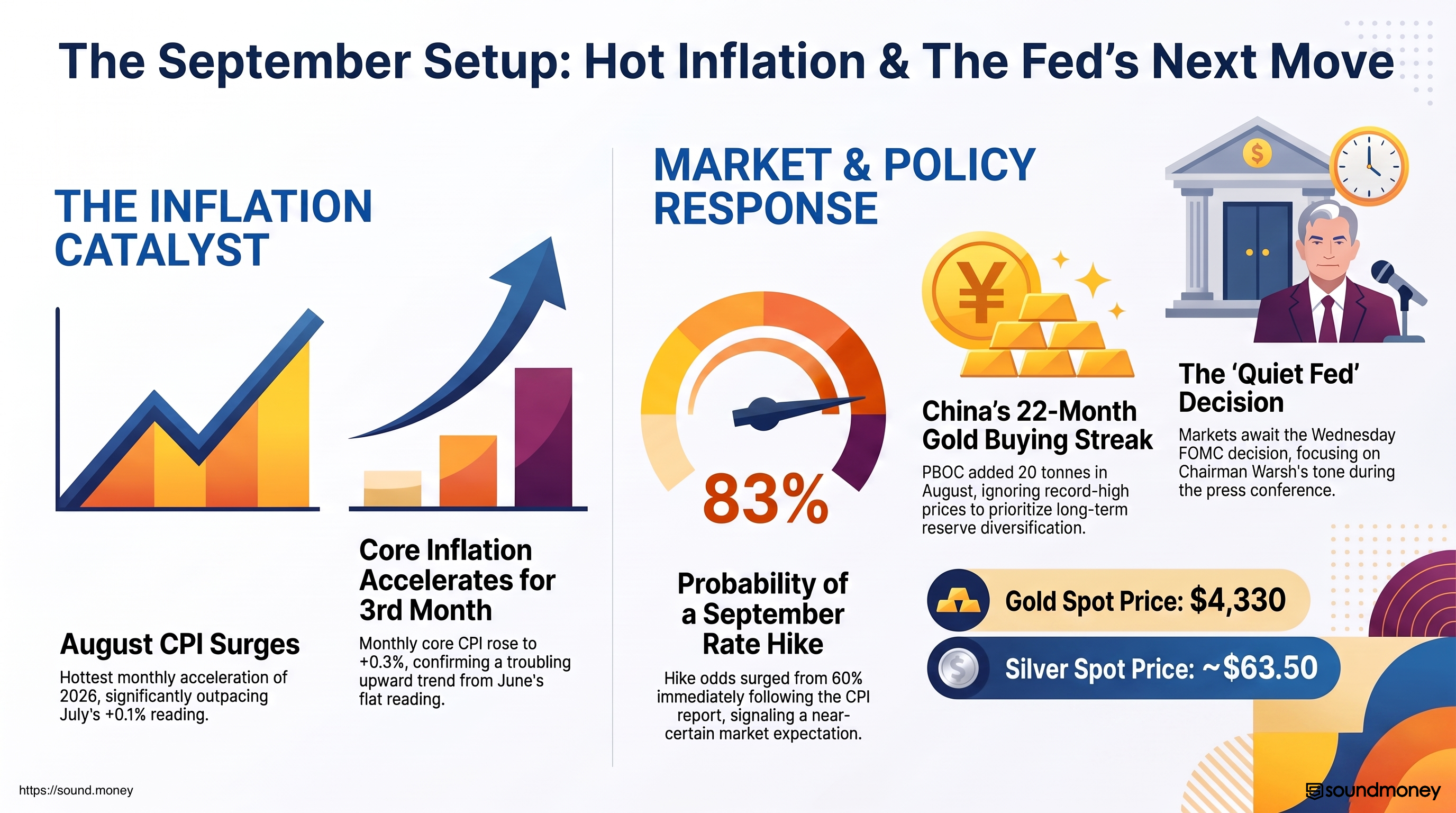
The data that was supposed to resolve September's uncertainty made it clearer — and it pushed the FOMC toward a hike.
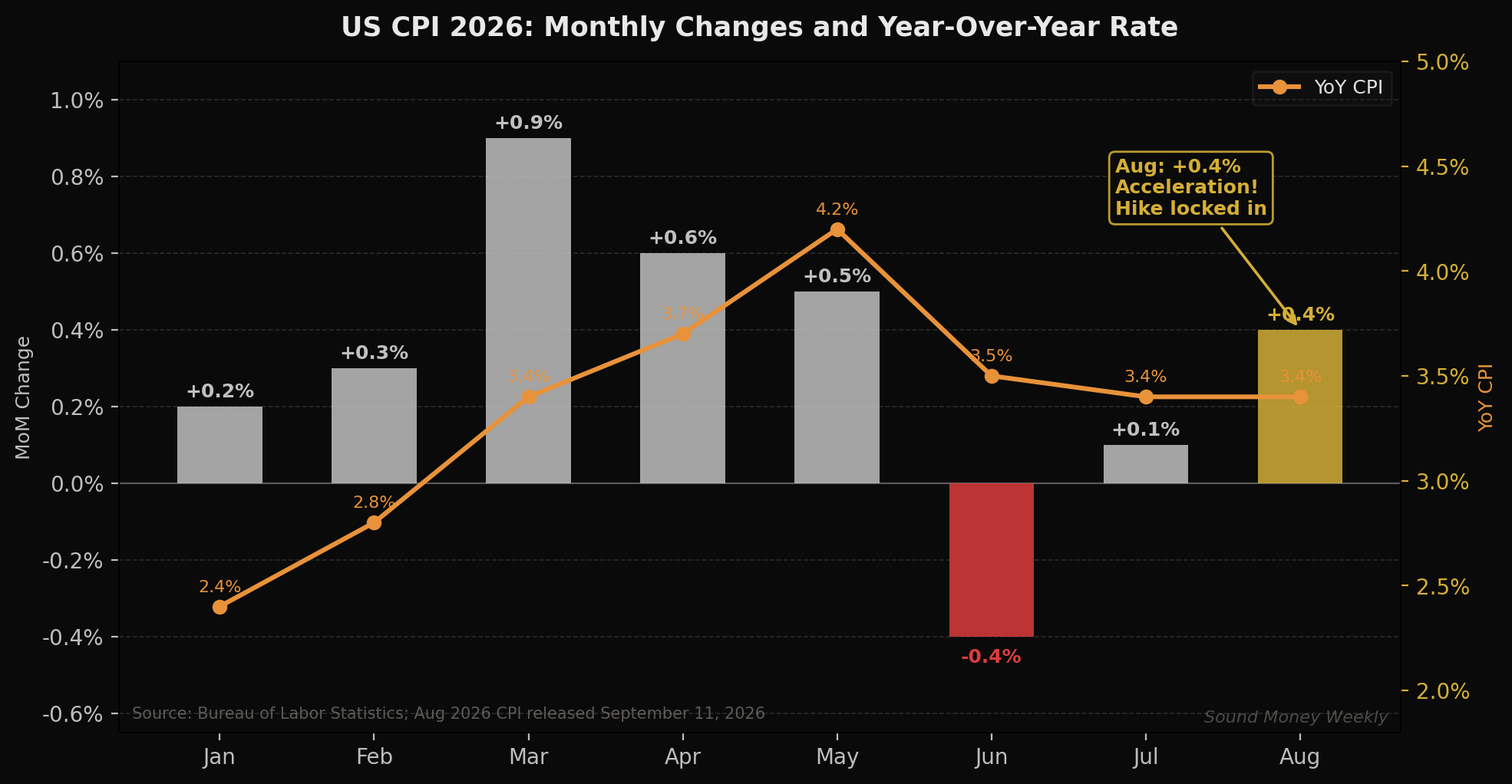
On Friday, the Bureau of Labor Statistics reported August CPI at +0.4% month-over-month — well above July's +0.1% and the hottest monthly reading of 2026 outside March's Iran-war energy spike. Core CPI (excluding food and energy) accelerated to +0.3% month-over-month, also above July's +0.2%. Year-over-year, the headline rate held at 3.4% — exactly where it was in July, confirming no further progress.
Reuters framed it directly: the report "is likely to result in the Federal Reserve raising interest rates next week." September rate-hike odds surged from 60% to 83-85% immediately after the release.
The FOMC meets Tuesday and Wednesday. The decision arrives Wednesday afternoon.
Gold is at $4,330. Silver is at approximately $63.50. China quietly added another 20 tonnes last month.
The August CPI Report: What Accelerated
The August report's headline number — 3.4% year-over-year — appears unchanged from July. But the composition of how that number arrived is significantly different.
Monthly acceleration: CPI rose 0.4% in August after rising just 0.1% in July. The driver was energy: gasoline prices rose sharply as Middle East tensions (the Hormuz situation's residual tail) kept oil elevated, reversing some of June and July's energy-driven disinflation. The 3.4% annual rate was "maintained" by energy bouncing back, not by underlying price stability improving.
Core CPI acceleration: The more concerning number was core CPI's 0.3% monthly increase. Core prices had been flat in June (0.0%), up 0.2% in July, and are now up 0.3% in August. The three-month sequential acceleration — from flat to 0.2% to 0.3% — is exactly what Warsh said at Jackson Hole he wasn't satisfied with. "We must be confident that underlying inflation is moving to our objective, clearly and at sufficient speed." The August data says that confidence is not yet warranted.
The New York Times captured the stance: "U.S. inflation stayed stubbornly high in August, bolstering the case for the Federal Reserve to raise interest rates at its meeting next week."
The September Rate-Hike Setup
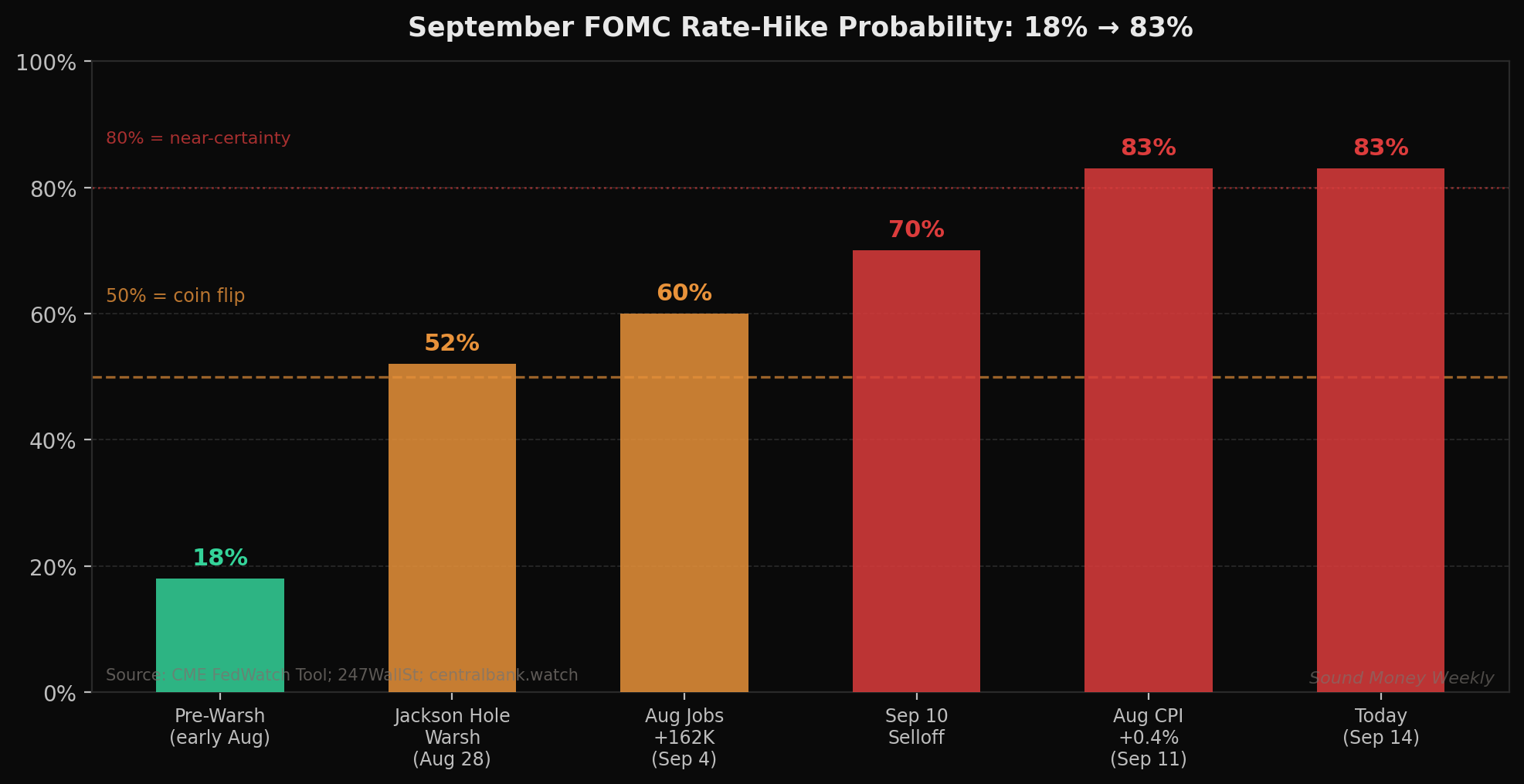
The probability of a 25-basis-point rate hike at the September 16-17 FOMC has traveled a long road in six weeks. At the start of August, September hike odds were below 20%. Warsh's hawkish Jackson Hole speech drove them to 52%. Strong August jobs (+162,000) pushed them to 60%. The silver selloff on September 10 reflected pre-CPI positioning. And now, hot August CPI has driven the market to 83% implied probability.
At 83%, September's hike is not a "lean" — it's a near-certainty in market pricing. The 17% remaining probability accounts for scenarios where Warsh surprises with a hold despite the data, or where some emergency disinflationary development in the next 48 hours alters the calculus.
What would a hike look like? Under Warsh's "quieter Fed" philosophy — no forward guidance, no pre-commitment — the hike would arrive with minimal framing about what comes next. The statement itself will be short. The press conference tone will be the only signal about whether this is a one-time move or the beginning of a tightening sequence.
For gold, the actual decision matters less than the language around it. A hike with "one and done" framing would be quickly absorbed. A hike with "further action may be necessary" framing would extend the pressure.
Silver's Week: -5.73% and a New Market Structure
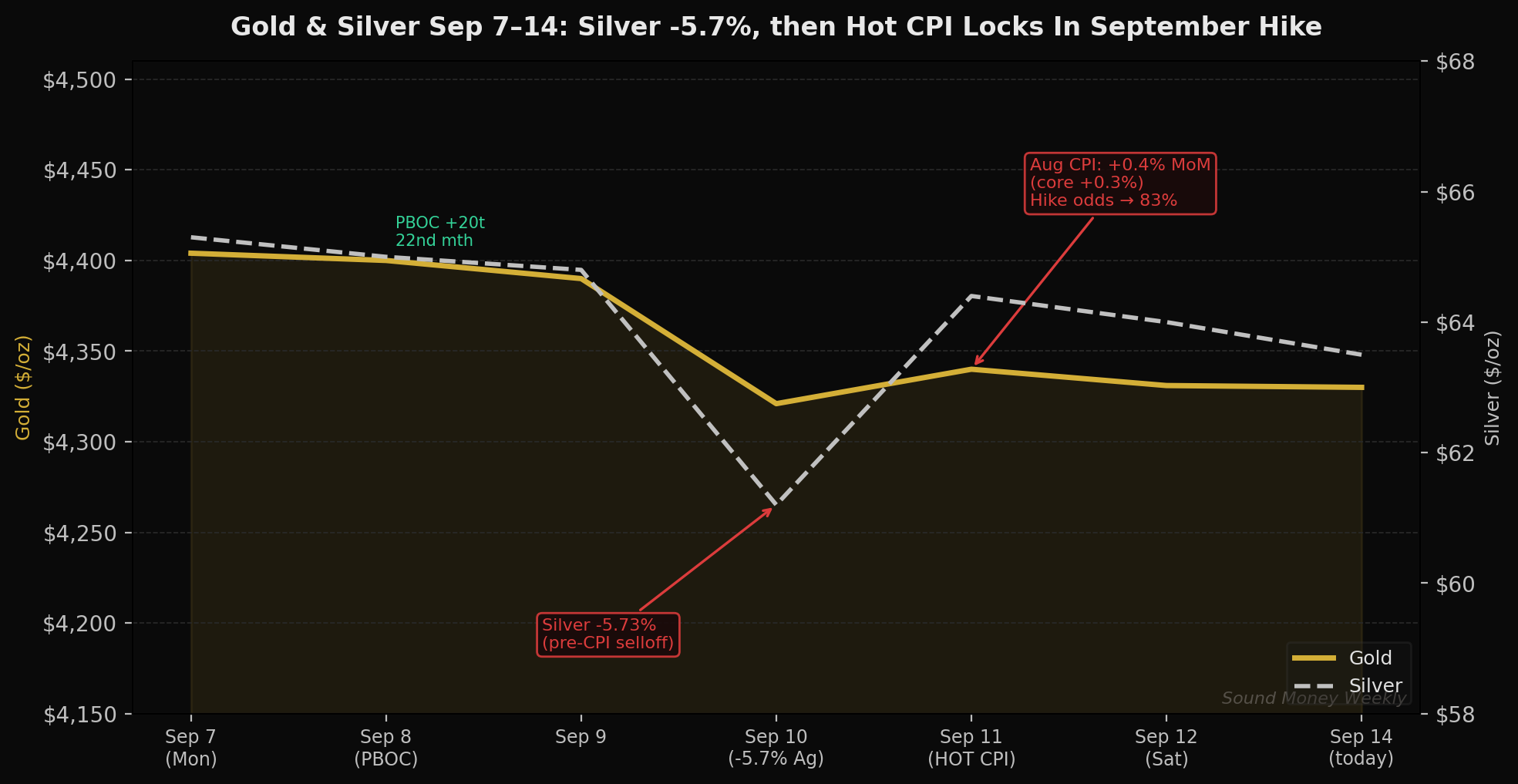
Tuesday, September 10 delivered one of the week's sharper single-session moves: silver fell 5.73%, dropping to $64.72 from a prior close of $68.65. Gold fell 1.63% on the same session. The selloff was predominantly pre-CPI positioning — traders reducing silver exposure ahead of an inflation print that, if hot, would accelerate rate hike expectations and strengthen the dollar.
The market was right. The CPI was hot. But silver partially recovered — settling at $64.39 on Friday, up 1.46% on the day after Thursday's slide. It's at approximately $63.50 today.
The week also brought a quiet but structurally significant development: CME Group launched 24/7 trading on 100-ounce silver futures, beginning with weekend trading on September 11 at 4:30pm CT. This extends the same always-on market structure that CME previously introduced for gold.
Here is why that matters structurally: CME doesn't expand trading hours because it's convenient. It expands them because the audience demands it. The decision to make silver futures available 24 hours a day, 7 days a week — including Sunday afternoons — reflects a fundamental shift in who participates in silver markets. Crypto traders who are comfortable buying assets at 3am on a Saturday, Asian institutional investors operating on Hong Kong Standard Time, European early-morning sessions — all of them now have continuous price discovery in silver alongside gold.
The metals markets are being integrated into the global always-on financial ecosystem. That's not a technical footnote. It's a structural statement about silver's expanding role as a globally traded financial asset.
PBOC's 22nd Month: Buying at Any Price
The People's Bank of China reported on September 8 that it added 650,000 ounces — approximately 20.22 tonnes — to its gold reserves in August. This extends the PBOC's consecutive buying streak to 22 months.
August's addition happened while gold averaged approximately $4,500-$4,700 during the month — among the highest prices in history. China did not stop. It did not slow. The 22-month streak now represents the longest unbroken central bank gold accumulation in the modern reserve data era.
The structural read is unchanged from what it has been for nearly two years: China's reserve managers are not operating on price signals. They are executing a long-term strategic shift toward non-dollar reserve assets, and the monthly gold purchases are how that shift is expressed. A $4,600 spot price is not a deterrent when the objective is reserve diversification over decades, not quarters.
What This Means for the DCA Investor
Gold at $4,330 and silver at $63.50 are entering the most important week of the current rate cycle. Whatever the FOMC decides on Wednesday will reset the rate narrative that has driven metals since Warsh's hawkish June debut.
The two scenarios:
If Warsh hikes 25bps and signals it's a one-time adjustment to ensure disinflation continues — gold likely absorbs the move, potentially recovering to $4,400-$4,500 in the weeks following as the market prices in eventual cuts.
If Warsh hikes and maintains the "work to do" posture — gold faces more pressure, potentially testing $4,200-$4,300. This is the scenario where the 83% hike probability fails to fully account for the follow-through risk.
The DCA math at $4,330:
- $200/month buys 0.04619 oz — still 29.5% more metal per dollar than January's $5,608 all-time high
- Over 12 months: 0.5543 oz accumulated on $2,400 invested
- At Goldman's $4,900 target: worth $2,716 — a +13.2% return on contributions
The DCA investor in September 2026 is buying gold that has already absorbed six weeks of hawkish repricing — Jackson Hole, strong jobs, hot CPI. If the Wednesday decision is already priced in at 83%, the incremental downside from a hike alone is limited. The risk is Warsh's follow-on language, not the quarter-point itself.
What We're Watching
FOMC Decision — Wednesday September 17
Warsh holds a press conference after every meeting. In a "quiet Fed" framework, the press conference is the only forward signal available. Watch specifically: does he characterize September as completing a cycle, or opening one?
Gold's Response to the Hike
The historical pattern after rate hikes is complex: gold often sells off immediately, then recovers within days to weeks as the market prices in the path from "peak rate" to eventual cut. The key variable is whether 4.25% (the new rate if hiked from 3.75%) is viewed as the terminal rate or a waystation.
Silver's Industrial Demand Update
With CME's new 24/7 structure in place and the sixth consecutive annual deficit running, silver's fundamental supply-demand picture hasn't changed. The short-term rate headwind is real; the structural deficit is real. Both coexist.
Next Inflation Read — October 15
September CPI arrives October 15, five weeks after today. If September CPI shows the August acceleration was a one-month anomaly (energy-driven), the rate narrative softens significantly. If September CPI continues at 0.3-0.4% monthly, the December hike becomes the next live meeting.
The Bottom Line
The week leading into the September 16-17 FOMC contained the data Warsh said he needed: inflation that is not moving clearly and at sufficient speed toward 2%. August's 0.4% monthly CPI acceleration confirmed his point. The market responded by pricing 83% hike odds. China responded by buying another 20 tonnes.
The FOMC decision Wednesday is now almost certainly a 25-basis-point hike — the first since Warsh became chair and the first since 2019. What happens to gold depends almost entirely on what Warsh says in the seven minutes after the decision is announced.
This article is for informational purposes only and does not constitute investment advice. Past performance of gold and silver prices is not indicative of future results. Always conduct your own research and consult a qualified financial advisor before making investment decisions. Sound Money provides fractional precious metals ownership services — see sound.money for full terms and conditions.
- gold
- silver
- precious-metals
- cpi
- inflation
- federal-reserve
- fomc
- rate-hike
- pboc